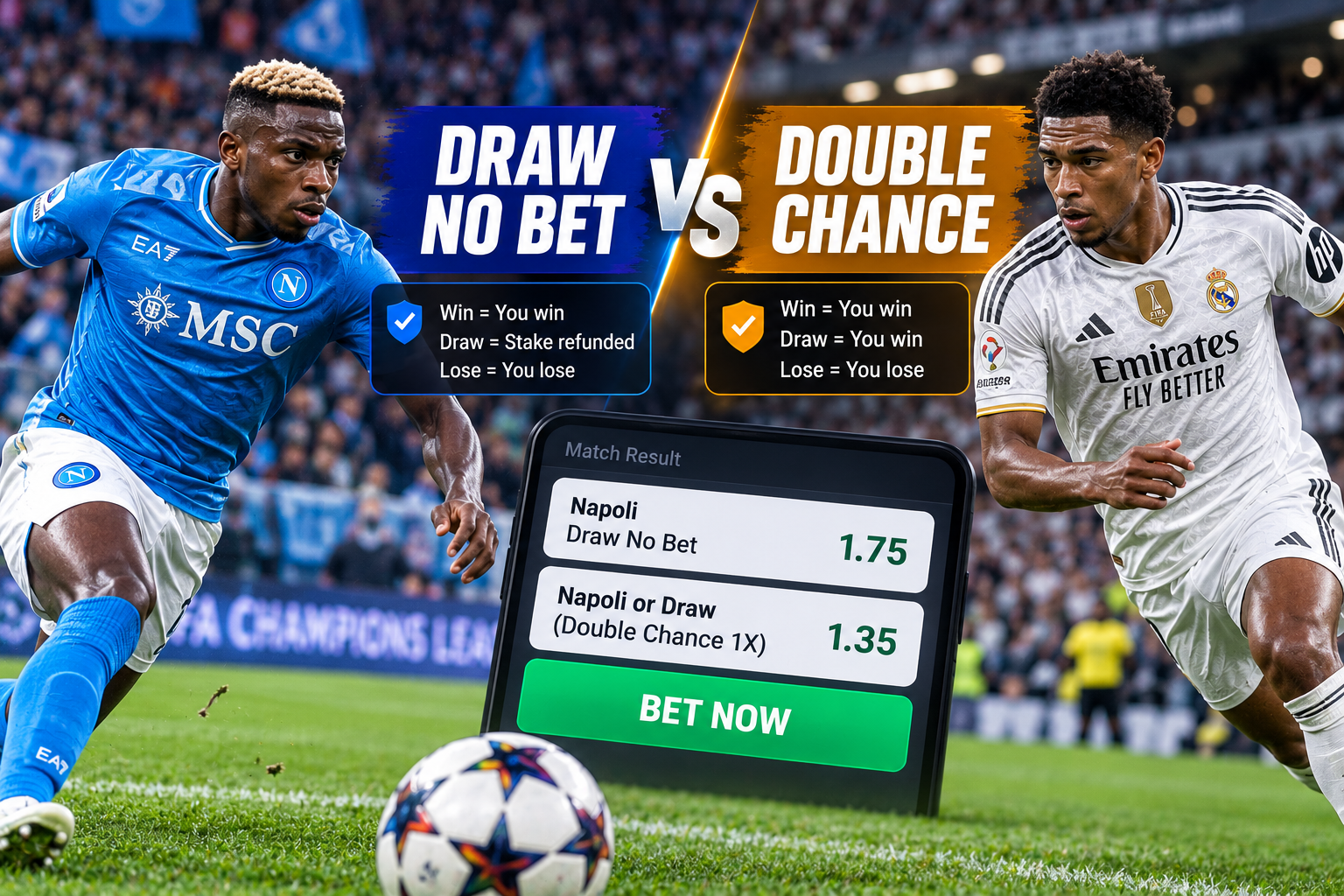
Draw No Bet vs Double Chance Calculator
Calculate potential returns and profits in Nigerian Naira.
Imagine watching Enyimba face Rivers United in a Nigerian Professional Football League fixture. You believe Enyimba have a good chance of winning at home, but Rivers United’s defensive approach makes a draw a realistic possibility.
Your sportsbook offers two selections:
- Enyimba Draw No Bet — 1.75
- Enyimba or Draw (1X) — 1.35
Both selections protect you from losing your entire stake if the match finishes level. Yet they do not provide the same protection, and they do not pay the same amount.
With Draw No Bet, a draw returns your original stake without profit. With Double Chance 1X, a draw counts as a winning selection and pays at the quoted odds.
That distinction is the foundation of Draw No Bet vs Double Chance, but understanding which market offers better value requires examining the prices, potential payouts, probability of each result, and how the selection behaves inside an accumulator.
This guide uses hypothetical Nigerian football scenarios and transparent naira calculations to explain the difference without treating either market as a guaranteed winning strategy.
The Same Football Match, Three Different Financial Outcomes
Assume Enyimba play Rivers United, and you stake ₦5,000 on either Enyimba Draw No Bet or Double Chance 1X.
The odds are hypothetical, not current bookmaker quotations.
| Final result | Enyimba DNB at 1.75 | Enyimba 1X at 1.35 |
|---|---|---|
| Enyimba win 1–0 | ₦8,750 return | ₦6,750 return |
| Match draws 1–1 | ₦5,000 refund | ₦6,750 return |
| Rivers United win 2–1 | ₦0 | ₦0 |
This single comparison reveals the trade-off.
If Enyimba win, Draw No Bet returns ₦2,000 more than Double Chance.
Whether the match ends in a draw, Double Chance returns ₦1,750 more than Draw No Bet.
Even if Rivers United win, both selections lose.
The difference is not simply that one market is safer. Both protect against a draw in different ways, while neither protects against defeat by the opposing team.
Why a refund is not a winning bet
A ₦5,000 refund means receiving the same ₦5,000 originally staked.
Your net profit is ₦0.
A ₦6,750 winning return means receiving the original stake plus ₦1,750 profit.
Confusing returned stake with profit is one of the most common mistakes when comparing these markets.
Understanding Draw No Bet Without Confusing It With a Draw Prediction
Draw No Bet (DNB) is a market where you select one team to win. If the match ends level, the selection is voided and your stake is returned.
In standard football betting notation:
1 DNB means the home team must win for the selection to pay. A draw refunds the stake.
2 DNB means the away team must win for the selection to pay. A draw refunds the stake.
There is no ordinary third DNB selection for backing the draw itself.
For example, suppose Arsenal host Chelsea.
If you select Arsenal Draw No Bet:
- Arsenal win 2–0: selection wins.
- Match finishes 0–0: stake refunded.
- Chelsea win 1–0: selection loses.
The refund does not mean the bookmaker predicts a draw. It is simply the agreed settlement condition if neither team wins.
Why bookmakers offer lower DNB odds than a straight win
A standard 1X2 home-win selection loses when the match ends in a draw.
A home Draw No Bet selection does not.
Because the bookmaker has removed the draw as a losing outcome, DNB typically pays lower odds than backing the same team to win outright.
Consider hypothetical prices for one match:
| Market | Decimal odds |
|---|---|
| Home win (1X2) | 2.20 |
| Home Draw No Bet | 1.75 |
| Home or Draw (1X) | 1.35 |
These prices illustrate how the payout changes as the settlement conditions become more favourable to the bettor.
They do not demonstrate that any selection has positive expected value.
Double Chance: Understanding 1X, X2 and 12
Double Chance combines two of the three standard full-time football results into one selection.
The three options are:
1X — Home Win or Draw
This selection wins if the home team wins or the match finishes level.
It loses only if the away team wins.
A 1X bet on Enyimba wins with results such as 2–0, 1–0, 1–1 or 0–0.
X2 — Away Win or Draw
This selection wins if the away team wins or the match finishes level.
It loses only if the home team wins.
A hypothetical X2 selection on Rivers United wins if Rivers United win 1–0 or the match ends 2–2.
12 — Either Team Wins
This selection wins if the match has a winner, regardless of whether the home or away team wins.
It loses if the match ends in a draw.
A 12 selection wins on 1–0 and 0–1, but loses on 0–0 or 2–2.
Important: Double Chance 12 is not the equivalent of Draw No Bet.
DNB backs a specific team and refunds a draw. Double Chance 12 backs either team to win and loses on a draw.
The Crucial Difference Between DNB and 1X
When comparing a home Draw No Bet selection with Double Chance 1X, both bets have the same losing outcome: an away victory.
The difference appears when the home team wins or the match draws.
On a home win, DNB usually pays more.
On a draw, DNB refunds the stake while 1X pays a winning return.
This means the comparison should focus on how much extra profit DNB offers when the home side wins and how much profit 1X offers when the match finishes level.
Suppose your stake is ₦10,000.
DNB odds: 1.80.
1X odds: 1.40.
If the home team wins:
DNB returns ₦18,000, producing ₦8,000 profit.
1X returns ₦14,000, producing ₦4,000 profit.
DNB offers an additional ₦4,000 profit.
If the match draws:
DNB returns ₦10,000, producing no profit.
1X returns ₦14,000, producing ₦4,000 profit.
The draw therefore produces a ₦4,000 advantage for 1X.
This particular pricing makes the comparison symmetrical, but real markets may offer different differences between win and draw payouts.
How to Calculate Draw No Bet Winnings in Naira
The standard decimal-odds formula applies when the selected team wins.
Total return = Stake × Decimal odds
Net profit = Total return − Stake
Suppose you place ₦3,500 on a home-team DNB selection at 1.65.
If the home team wins:
₦3,500 × 1.65 = ₦5,775 total return.
Net profit:
₦5,775 − ₦3,500 = ₦2,275.
If the match draws, the return is ₦3,500.
If the away team wins, the return is ₦0.
A DNB calculator must account for all three outcomes. Simply multiplying the stake by the odds without considering the draw-refund condition produces an incomplete calculation.
How to Calculate Double Chance Winnings
Double Chance uses the same standard decimal-odds calculation when the selection wins.
Suppose you stake ₦3,500 on Double Chance 1X at 1.32.
A home win or draw returns:
₦3,500 × 1.32 = ₦4,620.
Net profit:
₦4,620 − ₦3,500 = ₦1,120.
An away win loses the selection.
Unlike DNB, a standard Double Chance 1X bet does not refund merely because the match ends level. A draw is already one of the winning results covered by the selection.
Which Is Better Value: Draw No Bet or Double Chance?
A higher payout does not necessarily represent better value.
The answer depends on the relationship between the bookmaker’s odds and the probability of each match result.
For a more rigorous comparison, consider three estimated probabilities:
- Home win probability: 45%.
- Draw probability: 30%.
- Away win probability: 25%.
These figures are hypothetical and are used to demonstrate the calculation.
Suppose the sportsbook offers:
Home DNB: 1.75.
Double Chance 1X: 1.35.
Expected value of Home DNB
Home win: ₦1 stake → ₦0.75 profit.
Draw: net profit zero.
Away win: ₦1 stake lost.
Expected net profit per ₦1:
(0.45 × 0.75) + (0.30 × 0) − (0.25 × 1)
= 0.3375 − 0.25
= ₦0.0875.
That represents an estimated expected return on stake of +8.75%.
Expected value of Double Chance 1X
If the home team wins or the match draws, a ₦1 stake produces ₦0.35 profit.
Combined probability of those outcomes:
45% + 30% = 75%.
Expected net profit per ₦1:
(0.75 × 0.35) − (0.25 × 1)
= 0.2625 − 0.25
= ₦0.0125.
That represents an estimated expected return on stake of +1.25%.
Under these particular hypothetical probabilities and prices, DNB has the higher estimated monetary value.
However, the example does not prove DNB is generally superior. Change the probabilities or the quoted odds, and the conclusion may change.
In real betting markets, estimating probabilities accurately is difficult. Bookmaker margins, uncertainty and model errors can eliminate any apparent advantage.
A More Useful Way to Compare DNB and 1X Odds
Rather than automatically choosing the market with the higher price, calculate the minimum probability required for each selection to break even.
For Double Chance 1X:
Break-even probability = 1 ÷ Decimal odds
At odds of 1.35:
1 ÷ 1.35 = 74.07%.
That means the combined probability of a home win or draw would need to exceed approximately 74.07% for a positive expected monetary return, ignoring additional adjustments.
DNB requires a different calculation because a draw refunds the stake.
For Home DNB:
Break-even conditional win probability = 1 ÷ DNB odds
At 1.75:
1 ÷ 1.75 = 57.14%.
This is the required probability of the home team winning among matches that do not end in a draw.
It is not the unconditional probability of a home win.
To estimate that conditional probability:
Home win probability ÷ (Home win probability + Away win probability)
Using the earlier example:
45 ÷ (45 + 25) = 64.29%.
Because 64.29% exceeds 57.14%, the hypothetical DNB price has positive estimated value under those assumptions.
These calculations explain why comparing the two odds directly without accounting for draws can produce misleading conclusions.
A Nigerian Football Scenario: When a Draw Is More Likely Than You Think
Consider a hypothetical NPFL fixture between two teams with contrasting styles.
The home side creates frequent chances but struggles to convert them. The away side defends compactly and regularly limits opponents’ opportunities.
You might expect the home team to avoid defeat, but a 0–0 or 1–1 draw could still be plausible.
This is the kind of scenario where the difference between DNB and Double Chance becomes relevant.
DNB provides no profit if the match draws.
Double Chance 1X does.
However, that does not automatically make Double Chance better value. If the sportsbook has already priced the draw probability into very short 1X odds, the selection may offer little expected return.
To assess the fixture, examine recent performances against comparable opposition, home and away records, injuries, expected goals, clean-sheet rates and confirmed lineups.
Avoid using raw head-to-head results as the sole basis for a selection. Previous meetings may involve different managers, players and tactical conditions.
What Happens to Draw No Bet in an Accumulator?
DNB behaves differently in an accumulator because a draw normally voids the DNB leg instead of losing the entire ticket.
Suppose a three-selection accumulator contains:
| Selection | Odds | Result |
|---|---|---|
| Arsenal win | 1.80 | Won |
| Enyimba Draw No Bet | 1.60 | Draw |
| Real Madrid win | 1.50 | Won |
Original combined odds:
1.80 × 1.60 × 1.50 = 4.32.
A ₦2,000 stake would have produced ₦8,640 if all three selections won.
But Enyimba’s DNB selection finished in a draw.
Under standard accumulator void-leg rules, its odds become 1.00.
Revised combined odds:
1.80 × 1.00 × 1.50 = 2.70.
Revised total return:
₦2,000 × 2.70 = ₦5,400.
The accumulator can still win because the other two selections won.
This is not the same as a full-ticket refund.
Only the void leg is removed from the multiplication.
Promotional bonuses, minimum-leg requirements and bookmaker-specific rules may change the final settlement.
For a detailed explanation of accumulator calculations, read How to Calculate Accumulator Odds in Nigeria.
Double Chance in an Accumulator: The Draw Counts as a Win
Now consider the same three-match accumulator, but replace Enyimba DNB with Enyimba Double Chance 1X at 1.30.
Arsenal win at 1.80.
Enyimba draw, satisfying 1X at 1.30.
Real Madrid win at 1.50.
Combined odds:
1.80 × 1.30 × 1.50 = 3.51.
With a ₦2,000 stake, the total return is:
₦2,000 × 3.51 = ₦7,020.
In this hypothetical example, the Double Chance accumulator returns ₦1,620 more than the accumulator containing a voided DNB selection.
But if Enyimba had won, the original DNB accumulator would have returned ₦8,640, exceeding the Double Chance accumulator by ₦1,620.
This is the practical trade-off between earning a higher price on a win and receiving a winning settlement on a draw.
Is Draw No Bet the Same as Asian Handicap 0?
For standard football settlement rules, Draw No Bet and Asian Handicap 0.0 generally produce the same outcomes.
Back the home team on either market:
- Home win: selection wins.
- Draw: stake refunded.
- Away win: selection loses.
Despite matching settlement conditions, sportsbooks may display different prices for the two markets.
If the selection, team and match period are identical, compare the available odds and terms rather than assuming the market labels imply different outcomes.
This equivalence does not extend to Asian Handicap +0.25 or -0.25, where quarter-goal settlement can involve half wins, half losses or partial refunds.
Does Extra Time Count for DNB or Double Chance?
Standard full-time football markets are normally settled after 90 minutes plus stoppage time.
Extra time and penalty shootouts are excluded unless the market specifically says otherwise.
Imagine a Champions League knockout match that finishes 1–1 after 90 minutes.
The home team then scores during extra time and wins 2–1.
Home DNB selection draws → stake refunded.
For standard full-time 1X, bet wins since home side avoided 90-minute defeat.
Double Chance 12 loses because 90-minute match finished level.
Always check the named settlement period before placing the selection, particularly in cup competitions.
Five Errors That Change the Meaning of a Betting Slip
Mistaking 12 for Draw No Bet
Double Chance 12 backs either team to win. A draw loses.
DNB backs one specific team and refunds a draw.
Thinking a DNB refund generates profit
A refund returns the original stake. It is not a winning return.
Assuming 1X and X2 mean the same thing
1X covers home win or draw. X2 covers away win or draw.
They protect different teams.
Ignoring decimal odds when comparing markets
A market can cover more outcomes while paying so little that it offers poor estimated value.
Compare the actual odds, not merely the number of covered results.
Forgetting that an accumulator can still lose
A voided DNB leg does not rescue an accumulator containing another losing selection.
The remaining active selections must still satisfy their conditions.
Draw No Bet vs Double Chance: Questions Nigerian Bettors Ask
What is the difference between Draw No Bet and Double Chance?
Draw No Bet pays if the selected team wins and refunds the stake if the match draws. Double Chance 1X or X2 pays if the selected team wins or the match draws.
What does Draw No Bet 1 mean?
It means backing the home team to win, with the stake refunded if the match ends in a draw.
What does Draw No Bet 2 mean?
It means backing the away team to win, with the stake refunded if the match finishes level.
Does Double Chance 1X win on a 0–0 draw?
Yes. A 0–0 result satisfies the draw outcome included in 1X.
Does Draw No Bet win on a 0–0 draw?
No. The stake is normally refunded.
Which has higher odds, DNB or Double Chance?
For the same team and match, DNB typically offers higher odds than 1X or X2 covering that team and a draw. Actual prices vary.
Is Draw No Bet safer than Double Chance?
Neither guarantees a positive return. DNB refunds draws; Double Chance 1X or X2 pays on draws. Both lose if the opposing team wins.
What happens when a DNB accumulator selection draws?
The selection is normally voided and treated as odds of 1.00. The remaining selections determine whether the accumulator wins.
Can Draw No Bet lose?
Yes. If the opposing team wins during the qualifying match period, the DNB selection loses.
Is Double Chance 12 the same as DNB?
No. Double Chance 12 loses on a draw, whereas DNB refunds a draw.
Is Asian Handicap 0 the same as DNB?
Yes, their standard win, refund and loss conditions match when the selected team and settlement period are identical.
How do I calculate DNB winnings?
Multiply your stake by the decimal odds if your selected team wins. Return the stake if the match draws. A defeat returns nothing.
Final Analysis: Compare the Draw Outcome Before Comparing the Odds
The most important difference between Draw No Bet and Double Chance is how a draw is settled.
DNB turns the draw into a refund. Double Chance 1X or X2 turns the draw into a winning result.
That distinction changes the odds, the potential return and the expected value of each selection.
A bettor who expects a team to win may prefer the higher DNB payout, while someone who assigns substantial probability to a draw may find Double Chance more appealing. Neither preference establishes value without comparing the quoted odds against credible probability estimates.
Use the calculator to compare outcomes before making a decision. Verify the bookmaker’s rules, distinguish returns from profits, and avoid treating either market as guaranteed income.
Betting involves financial risk. Set spending limits, avoid chasing losses and never stake money needed for essential expenses.