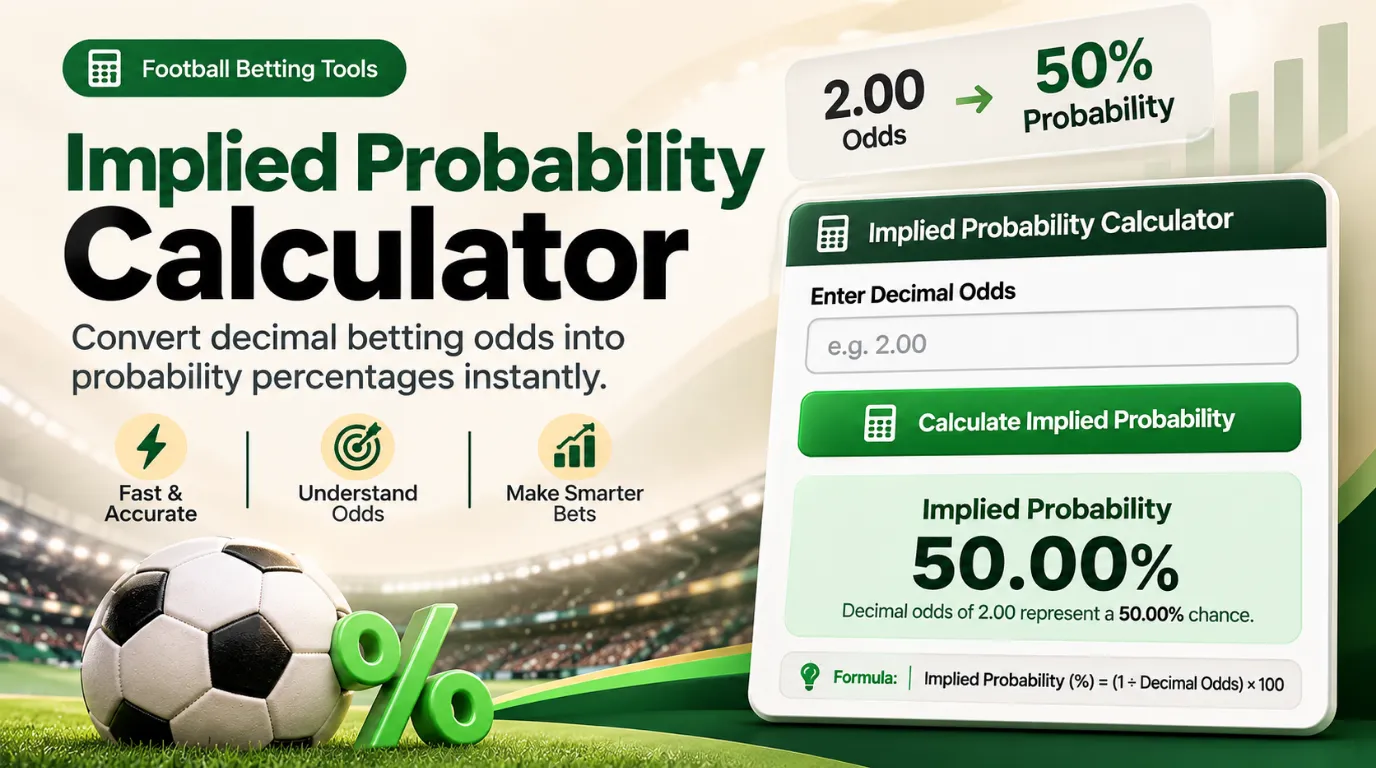
Convert decimal betting odds into an implied probability percentage with our free Implied Probability Calculator. Enter the decimal odds above to see the percentage represented by the betting price and better understand the mathematical relationship between odds and probability.
Enter your decimal odds into the calculator to get started.
Enter decimal odds greater than 1.00 to calculate the implied probability.
Enter decimal odds above to see the percentage represented by the price.
Whether you are comparing football betting markets, checking bookmaker prices or learning how betting odds work, implied probability provides a simple way to express odds as a percentage. Instead of looking only at a price such as 1.80, 2.00 or 4.50, you can see the probability that the odds represent.
How to Calculate Implied Probability from Decimal Odds
The standard formula for calculating implied probability from decimal odds is:
Implied Probability (%) = (1 ÷ Decimal Odds) × 100
The calculation converts a betting price into a percentage.
For example, if the decimal odds are 2.00:
(1 ÷ 2.00) × 100 = 50%
Therefore, decimal odds of 2.00 represent an implied probability of 50%.
Similarly, decimal odds of 4.00 represent:
(1 ÷ 4.00) × 100 = 25%
Our Implied Probability Calculator performs this calculation automatically. Simply enter the decimal odds and the tool will show the percentage represented by that price.
It is important to remember that implied probability is based on the odds entered. It does not guarantee that an event will happen, and it should not be treated as a prediction of a football match result.
Decimal Odds and Implied Probability Examples
The table below shows how common decimal odds convert into implied probability percentages.
| Decimal Odds | Implied Probability |
|---|---|
| 1.10 | 90.91% |
| 1.20 | 83.33% |
| 1.50 | 66.67% |
| 1.80 | 55.56% |
| 2.00 | 50.00% |
| 2.50 | 40.00% |
| 3.00 | 33.33% |
| 4.00 | 25.00% |
| 5.00 | 20.00% |
| 10.00 | 10.00% |
As the decimal odds become lower, the implied probability becomes higher. Conversely, higher decimal odds represent a lower implied probability.
For example, odds of 1.50 represent a higher implied probability than odds of 3.00. This relationship exists because shorter odds generally reflect a lower potential return relative to the stake, while longer odds represent outcomes with a lower implied probability.
What Does Implied Probability Mean in Betting?
Implied probability is the percentage chance mathematically represented by a set of betting odds.
Bookmakers display prices in different formats, including decimal, fractional and American odds. Although the formats look different, each price can be converted into a probability percentage.
For decimal odds, the conversion is straightforward using the formula above.
Suppose a football team has decimal odds of 2.00 to win a match. Those odds represent an implied probability of 50%. If another outcome has odds of 4.00, the implied probability is 25%.
However, this does not mean the first outcome has an exact 50% chance of happening in reality. The figure only shows the probability represented by the betting price.
Several factors can influence bookmaker odds, including market activity, risk management and the bookmaker’s margin. Therefore, implied probability is best understood as a way to analyse and compare betting prices rather than a guarantee of the actual result.
How to Use the Implied Probability Calculator
Our calculator is designed to make the conversion from decimal odds to probability quick and straightforward.
Follow these steps:
- Find the decimal odds you want to analyse.
- Enter the odds into the calculator.
- Select Calculate Implied Probability.
- Review the percentage shown in the result.
For example, entering 2.50 produces an implied probability of 40%.
You can use the calculator to check a single football selection or compare several different odds. This can be particularly useful when looking at match winner, goals, Both Teams to Score or other football betting markets.
The calculator works with decimal odds greater than 1.00.
Why Convert Betting Odds to Probability?
Betting odds can be easier to compare when they are expressed as percentages.
For example, comparing decimal odds of 1.67 and 2.75 requires some understanding of what those numbers represent. Once converted into implied probabilities, the relationship becomes clearer:
- Decimal odds of 1.67 represent approximately 59.88%.
- Decimal odds of 2.75 represent approximately 36.36%.
This does not tell you which selection will win. Instead, it helps you understand how the prices compare mathematically.
Converting odds to probability can help you:
- Understand the percentage represented by a betting price.
- Compare different football selections.
- Learn the relationship between odds and probability.
- Check how a bookmaker’s prices translate into percentages.
- Analyse the mathematics behind a betting market.
If you need to convert odds between different formats before using this calculator, visit our Odds Converter. It can help you compare decimal, fractional and American odds.
Implied Probability and Football Betting Odds
Football betting markets offer many possible outcomes, each with its own price. A match may include markets for the home win, draw and away win, as well as goals, Both Teams to Score, corners and other events.
Every set of odds can be converted into an implied probability.
For example, imagine a match has the following decimal odds:
- Home team to win: 1.80
- Draw: 3.60
- Away team to win: 4.50
Using the implied probability formula:
- 1.80 represents approximately 55.56%.
- 3.60 represents approximately 27.78%.
- 4.50 represents approximately 22.22%.
When these percentages are added together, the total is greater than 100%. This leads to another important concept in betting: the bookmaker margin.
What Is the Bookmaker Margin?
Bookmakers generally build a margin into the odds they offer. As a result, the combined implied probabilities across all outcomes in a market can exceed 100%.
Using the example above:
55.56% + 27.78% + 22.22% = 105.56%
The amount above 100% reflects the pricing margin built into the market.
This is one reason why implied probability should not automatically be considered the true probability of an event. The odds reflect the bookmaker’s pricing, which may include a margin and can also change as market conditions change.
Understanding this distinction can help you interpret betting odds more accurately.
Implied Probability vs Actual Probability
Implied probability and actual probability are not necessarily the same thing.
Implied probability comes directly from the betting odds. You can calculate it mathematically using the odds conversion formula.
Actual probability is an estimate of how likely an event is to happen based on available information and analysis.
In football, an estimate of actual probability might consider factors such as:
- Recent team form.
- Injuries and player availability.
- Home and away performance.
- Tactical matchups.
- Previous results and team statistics.
- Fixture importance.
- Squad rotation and fatigue.
Even with detailed analysis, no calculation can guarantee the result of a football match.
Our Implied Probability Calculator does not predict matches. It simply converts the odds you enter into the percentage represented by that price.
If you are looking for football match analysis rather than an odds calculation, you can also explore our football betting predictions.
How Does Implied Probability Relate to Decimal Odds?
Decimal odds and implied probability have an inverse relationship.
As decimal odds increase, implied probability decreases. As decimal odds decrease, implied probability increases.
Consider these examples:
Odds of 1.25
These represent an implied probability of 80%. The price suggests a relatively high probability compared with longer odds.
Odds of 2.00
These represent an implied probability of 50%.
Odds of 5.00
These represent an implied probability of 20%. The longer odds represent a lower implied probability.
This relationship makes implied probability useful for understanding the mathematical meaning behind betting prices.
Can You Calculate Implied Probability from Other Odds Formats?
Yes. Fractional and American odds can also be converted into implied probabilities. However, the calculation depends on the odds format.
Because this calculator focuses on decimal odds, you should first convert another format into decimal odds if necessary.
Our Odds Converter can help you convert between:
- Decimal odds.
- Fractional odds.
- American odds.
Once you have the decimal equivalent, you can enter it into this Implied Probability Calculator to see the corresponding percentage.
This makes the two tools useful together when you are comparing betting prices from platforms that use different odds formats.
Implied Probability and Potential Betting Returns
Implied probability explains the percentage represented by the odds, while a betting return calculator focuses on a different question: how much could a successful bet return?
For example, decimal odds of 2.00 represent an implied probability of 50%. If you place a stake of ₦1,000 at those odds, the potential total return would be ₦2,000, including the original stake.
To work out potential payouts based on your stake and decimal odds, use our Betting Return Calculator.
Using both tools can help you understand two different aspects of a betting price:
- The Implied Probability Calculator converts odds into a percentage.
- The Betting Return Calculator estimates the potential return from a stake.
Implied Probability for Multiple Football Selections
When several selections are combined in an accumulator, the odds and probabilities become more complex.
An accumulator combines multiple selections into one bet. The decimal odds for the selections are generally multiplied together to calculate the combined odds.
For example, three selections priced at 1.50, 1.80 and 2.00 produce combined decimal odds of 5.40.
The implied probability represented by the combined odds can then be calculated using the same formula:
(1 ÷ 5.40) × 100 = approximately 18.52%
If you want to understand how multiple selections create combined odds and potential returns, visit our Accumulator Calculator and guide.
Remember that accumulator settlement can vary depending on the bookmaker’s rules, particularly when a selection is void or subject to a special settlement condition.
Common Mistakes When Using Implied Probability
Implied probability is a simple calculation, but it can be misunderstood. Here are several important points to remember.
Treating implied probability as a guaranteed result
A probability percentage does not guarantee that an outcome will happen. Football matches can produce unexpected results regardless of the odds.
Forgetting the bookmaker margin
The implied probabilities in a market can add up to more than 100% because bookmakers generally include a margin in their pricing.
Confusing odds formats
The formula on this page is designed for decimal odds. Fractional and American odds require different calculations before conversion.
Assuming higher probability means a better selection
A higher implied probability simply represents the mathematical relationship shown by the odds. It does not automatically make a selection profitable or guarantee success.
Understanding these differences can help you use betting calculations more accurately.
Related Football Betting Calculators
8xbet9ja provides several tools designed to help with different betting calculations.
Need to compare different odds formats? Use our Odds Converter to convert between decimal, fractional and American odds.
Want to estimate a potential payout based on your stake? Our Betting Return Calculator calculates potential total returns and net profit.
For multiple football selections, the Accumulator Calculator can help you understand combined odds and potential returns.
You can also browse the complete collection of Football Betting Calculators and Tools to find the calculation that matches your needs.
Frequently Asked Questions
What is implied probability in betting?
Implied probability is the percentage represented mathematically by a set of betting odds. It helps translate a betting price into a percentage for easier comparison.
How do you calculate implied probability from decimal odds?
Divide 1 by the decimal odds and multiply the result by 100.
The formula is:
Implied Probability (%) = (1 ÷ Decimal Odds) × 100
What is the implied probability of 2.00 odds?
Decimal odds of 2.00 represent an implied probability of 50%.
What is the implied probability of 1.50 odds?
Decimal odds of 1.50 represent an implied probability of approximately 66.67%.
Does implied probability predict the outcome of a football match?
No. Implied probability converts a betting price into a percentage. It does not predict match results or guarantee that an outcome will happen.
Why do implied probabilities add up to more than 100%?
Bookmakers generally include a margin in their odds. Consequently, the combined implied probabilities for every possible outcome in a market can exceed 100%.
Can I use this calculator with fractional odds?
This calculator is designed for decimal odds. You can first use our Odds Converter to convert fractional odds into decimal odds.
Is implied probability the same as actual probability?
Not necessarily. Implied probability comes from the betting odds, while actual probability is an estimate of how likely an event is to happen. Bookmaker margins and market pricing can create a difference between the two.
Understand the Percentage Behind the Odds
Our Implied Probability Calculator provides a simple way to convert decimal betting odds into a percentage. Use it to understand the mathematical relationship between odds and probability, compare betting prices and learn more about how football betting markets are priced.
For broader information about football betting markets and odds, explore our football betting guides. You can also visit our football betting predictions for match-related football content.
Please remember: The percentage shown by this calculator is based solely on the odds entered. Betting odds can change, bookmaker margins can affect prices, and implied probability does not guarantee that a particular outcome will happen. Betting involves financial risk, so only stake what you can afford to lose.