Today’s AI Football Predictions
Our prediction model compares the available 1X2 probabilities for each fixture and identifies the outcome with the highest estimated likelihood. A higher percentage does not mean a guaranteed result.
AI football prediction
Enter the fixture details below, then press Predict to generate an AI football prediction.
Don't have a fixture yet? Browse match information on BallsFC or XtaBet , then return here to generate an AI prediction.
Prediction percentages represent model estimates based on available match data and should be interpreted as probabilities rather than certainties.
AI football predictions use data, statistical models and probability analysis to estimate how a football match may unfold. Rather than knowing the future, an AI football prediction system analyses available information such as team form, historical results, goals, expected goals, squad performance and market data to calculate the relative likelihood of different outcomes.
A prediction might estimate that a home win has a 60% probability, a draw has a 23% probability and an away win has a 17% probability. That does not mean the home team is guaranteed to win. It means that, based on the information and model assumptions available, a home victory is the most likely of the three outcomes.
This guide explains how AI football predictions work, what data football prediction models use, how probabilities and predicted scores are calculated, and how to interpret AI-generated match analysis alongside bookmaker odds.
For current match analysis and model-based selections, visit our football predictions today page.
What Are AI Football Predictions?
AI football predictions are estimates produced using computer models that analyse football data to identify patterns and calculate the probability of possible match outcomes.
Depending on the system, an AI football prediction model may evaluate:
- Recent team form
- Historical match results
- Goals scored and conceded
- Home and away performance
- Expected goals (xG)
- Shot and chance-creation data
- League and team strength
- Head-to-head information where relevant
- Squad availability
- Fixture congestion
- Historical performance patterns
- Current market odds
The output can take several forms. For example, a football prediction algorithm may estimate the probability of:
- Home win
- Draw
- Away win
- Both Teams to Score
- Over or Under a goals line
- A particular correct score
- Double Chance outcomes
The important distinction is that AI estimates probability, not certainty.
Football remains unpredictable. A red card, penalty, injury, deflection or individual moment can change a match in ways that no pre-match model can fully anticipate.
How AI Football Prediction Models Work
Modern football prediction systems generally follow a sequence: collect data, process relevant variables, identify statistical patterns and generate probabilities.
The exact technology varies. Some systems rely mainly on traditional statistical modelling, while others combine machine learning with large football datasets.
A simplified process looks like this:
Football data → Statistical analysis → Model inputs → Probability estimates → Match predictions
The quality of the final output depends heavily on the quality of the underlying data and the way the model is constructed.
1. Collecting Football Data
A prediction system first needs reliable match information.
Football data can include historical and current records such as:
- Fixtures and results
- Goals
- League tables
- Home and away records
- Team form
- Player and squad information
- Match events
- Shots and expected goals
- Pre-match odds
For dynamic football predictions, APIs can provide structured fixture and statistical data that is updated as new information becomes available.
However, more data does not automatically create a better prediction. A model must identify which variables are genuinely useful and avoid relying too heavily on irrelevant or outdated information.
2. Measuring Team Strength
One of the central tasks in football prediction is estimating how strong each team is.
A simple model might compare:
- Average goals scored
- Average goals conceded
- Recent results
- Home performance
- Away performance
More advanced football prediction models may also adjust for the strength of previous opponents.
For example, a team winning five matches against weak opposition should not automatically be rated the same as a team achieving similar results against stronger opponents.
Team strength is also not fixed. A club can improve or decline during a season because of:
- Managerial changes
- Injuries
- Transfers
- Tactical adjustments
- Changes in player form
- Fixture congestion
Therefore, useful AI football predictions should treat team performance as something that can change rather than assuming a club’s historical reputation tells the whole story.
The Role of Team Form in AI Match Predictions
Recent form is one of the most familiar inputs in football analysis.
A model may review recent results, but results alone provide an incomplete picture.
For example, two teams may both have won four of their last five matches. However, their underlying performances could be very different.
One team may have:
- Created many high-quality chances
- Controlled possession in dangerous areas
- Won comfortably
The other may have:
- Scored late winners
- Faced weak opponents
- Conceded many chances
- Benefited from unusually efficient finishing
As a result, stronger football prediction models combine recent results with performance indicators.
The goal is not simply to answer, “Who has won the most recently?” Instead, the model attempts to estimate the teams’ current underlying strength.
Expected Goals (xG) and AI Football Predictions
Expected goals, commonly called xG, is an important concept in modern football analysis.
An xG model estimates the probability that a particular scoring opportunity will result in a goal based on characteristics of the chance.
These characteristics can include factors such as:
- Shot location
- Distance from goal
- Angle
- Type of assist
- Body part used
- Other contextual information, depending on the model
A shot with an xG value of 0.20 can be interpreted as a chance with an estimated 20% probability of becoming a goal according to that model.
Why xG Can Be Useful
Final scores contain valuable information, but they do not always show how a match was played.
A team can win 1-0 after creating several excellent chances. Another team can win 1-0 from its only major opportunity.
Expected goals can add context by measuring the quality of opportunities created and conceded.
For AI football predictions, xG may help estimate:
- Attacking strength
- Defensive vulnerability
- Whether recent results match underlying performance
- Expected goal totals
However, xG is not a guarantee of future goals.
A team with 2.0 xG can score zero times, while another with 0.5 xG can score twice. Football outcomes contain natural variation.
Therefore, xG should be treated as one input within a broader football prediction model.
How Poisson Models Predict Football Scores
One of the best-known statistical approaches to football prediction is the Poisson model.
A Poisson model estimates the probability of a team scoring a particular number of goals based on an expected scoring rate.
Suppose a simplified model estimates:
- Home team expected goals: 1.60
- Away team expected goals: 0.90
The model can calculate probabilities for possible scores, including:
- 0-0
- 1-0
- 1-1
- 2-0
- 2-1
- Other scorelines
By combining the probabilities of different scorelines, the system can estimate broader match outcomes such as:
- Home win
- Draw
- Away win
- Over or Under goals
- Both Teams to Score
A Simple Example
Imagine a model produces these estimates:
| Outcome | Estimated probability |
|---|---|
| Home win | 54% |
| Draw | 25% |
| Away win | 21% |
The home team is the most likely winner according to the model.
However, the combined probability of a draw or away win is 46%.
Therefore, describing the match as a “certain home win” would be inaccurate.
This is why probability interpretation is essential when reading AI football predictions.
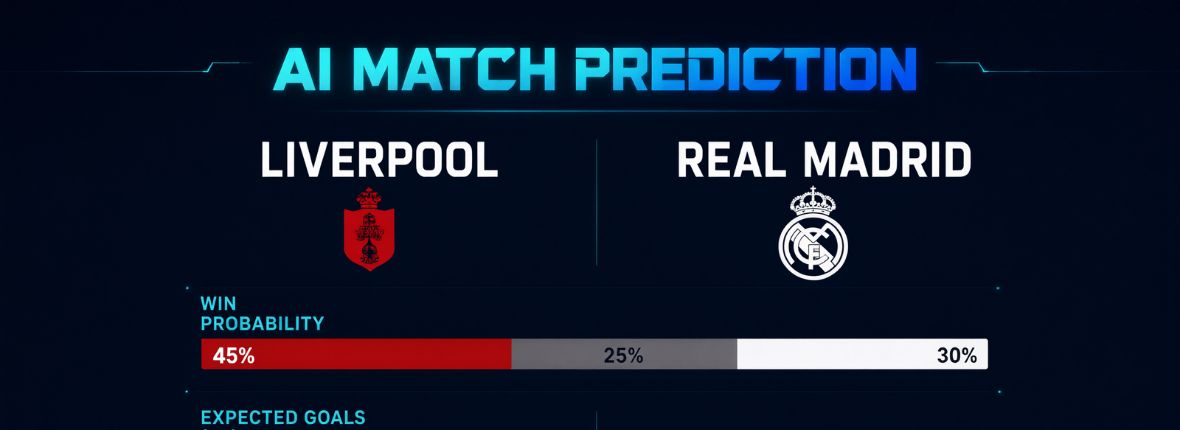
What Does a 60% Football Prediction Mean?
A common mistake is to interpret a 60% probability as a prediction that will definitely happen.
That is incorrect.
If a well-calibrated model assigns a similar type of outcome a 60% probability across many comparable events, the outcome would be expected to occur approximately 60 times out of 100 over a sufficiently large sample.
It can still lose in any individual match.
For example:
| Model probability | What it means |
|---|---|
| 50% | Outcome is approximately even |
| 60% | Outcome is more likely than not |
| 70% | Stronger estimated likelihood |
| 80% | Very strong model confidence, but not certainty |
| 100% | Certainty — rarely appropriate for a pre-match football forecast |
Even an 80% estimate leaves a meaningful possibility that the other outcome will occur.
A prediction percentage should therefore be read as a measure of estimated likelihood, not a promise.
AI Football Predictions vs Bookmaker Odds
AI models and bookmaker odds both express information about possible match outcomes, but they are created for different purposes.
A football prediction model attempts to estimate the probability of an outcome based on its data and methodology.
Bookmaker odds represent market prices. They are influenced by probability estimates, trading models, market activity and the bookmaker’s margin.
Converting Decimal Odds Into Probability
The basic formula is:
Implied probability = 1 ÷ decimal odds
For example:
| Decimal odds | Raw implied probability |
|---|---|
| 1.50 | 66.7% |
| 2.00 | 50.0% |
| 2.50 | 40.0% |
| 4.00 | 25.0% |
These figures are raw implied probabilities.
Importantly, bookmaker markets include a margin. When the implied probabilities for all possible outcomes are added together, the total can exceed 100%.
Therefore, comparing a model directly with raw odds without considering the market margin can be misleading.
Why Compare a Model With the Market?
Suppose a football prediction algorithm estimates:
Home win probability: 55%
A market price may imply a different probability after accounting for its margin.
The difference between independent model estimates and market expectations can be useful for analysis. However, a disagreement does not automatically prove that either side is wrong.
The model may have:
- Incomplete data
- Outdated inputs
- Poor calibration
- Missing contextual information
Likewise, market prices can move when new information becomes available.
The most useful approach is to understand what both sources are estimating rather than assuming either one can predict football perfectly.
What Do Dynamic Football Predictions Show?
Dynamic prediction pages can make football analysis easier to understand by presenting current model outputs for individual matches.
Depending on the available data, a dynamic prediction system may show:
- Home win probability
- Draw probability
- Away win probability
- Recommended market
- Predicted score
- Goals analysis
- BTTS analysis
- Match and competition information
For example, a prediction table may show:
| Match | Home | Draw | Away |
|---|---|---|---|
| Team A vs Team B | 58% | 24% | 18% |
The percentages help explain how the model sees the relative balance of the fixture.
However, users should consider the full distribution rather than looking only at the highest number.
A 58% home-win probability means the model still estimates a 42% combined chance of another result.
You can view current model-based analysis on our football predictions today page.
What Data Should an AI Football Prediction System Use?
There is no single list of inputs that guarantees an accurate prediction model.
However, useful football prediction systems may combine several categories of information.
Historical Match Performance
Historical data provides a larger context for understanding team and league performance.
Examples include:
- Previous results
- Goals scored
- Goals conceded
- Win, draw and loss rates
Historical information should be weighted carefully because older performances may become less relevant after major squad or managerial changes.
Recent Performance
Recent matches can reveal changes in current form.
Useful information may include:
- Recent results
- Goals
- Chances created
- Chances conceded
- Home and away splits
A short run of matches can also contain randomness, so recent form should not automatically override all longer-term information.
Match Context
The context of an individual fixture can matter.
Potential factors include:
- Home advantage
- Days of rest
- Fixture congestion
- Travel
- Competition format
- Squad rotation
- Confirmed player availability
Not every variable has the same predictive value in every match.
Market Information
Odds can provide an additional source of information because betting markets incorporate the views of traders and participants.
However, market odds should not be copied and presented as an independent AI prediction.
A transparent system should distinguish between:
- Model-generated estimates
- Market-derived probabilities
- Bookmaker prices
Can Artificial Intelligence Predict Football Matches Accurately?
Artificial intelligence can analyse large amounts of football information quickly and identify statistical patterns that may be difficult to process manually.
However, AI cannot remove uncertainty from football.
A football match is affected by events that are difficult to predict precisely, including:
- Injuries during a match
- Red cards
- Penalties
- Deflections
- Refereeing decisions
- Tactical changes
- Individual errors
- Exceptional individual performances
The better question is not whether AI can predict every football result correctly.
Instead, ask:
How well calibrated is the model, what data does it use, and how does it perform over a meaningful sample of predictions?
A credible football prediction system should be transparent about the difference between:
- A probability estimate
- A historical model result
- A guaranteed outcome
There is no reliable AI system that can guarantee football results before a match begins.
Machine Learning vs Traditional Football Prediction Models
The phrase “AI football predictions” can describe several different technologies.
Traditional Statistical Models
Traditional models use mathematical relationships to estimate outcomes.
Examples include:
- Poisson models
- Regression models
- Rating systems
- Probability distributions
These approaches can be relatively transparent because analysts can examine the assumptions and inputs.
Machine Learning Models
Machine learning models can analyse larger sets of variables and identify complex relationships in historical data.
Depending on the system, models may use techniques such as:
- Classification
- Regression
- Decision trees
- Ensemble methods
- Neural networks
However, complexity does not automatically make a model better.
A complicated machine learning system can still produce poor forecasts if:
- The data is unreliable
- The training sample is biased
- The model overfits historical results
- Important changes are not reflected in the inputs
For many football prediction tasks, a simpler and well-calibrated statistical model can outperform a more complicated model with poor data quality.
What Is Model Calibration?
Calibration measures whether predicted probabilities correspond reasonably with actual outcomes over a large number of events.
Imagine a model produces 100 predictions with a 70% probability.
If the model is well calibrated, approximately 70 of those outcomes would be expected to occur over a sufficiently large and comparable sample.
This does not mean every group of exactly 100 predictions will produce exactly 70 successful outcomes.
Natural variation exists.
Calibration is important because a model can correctly identify the most likely outcome while still assigning misleading probability values.
For example, two models might both select a home win as the most likely result, but one estimates 55% and the other 85%.
The difference matters when interpreting confidence.
Common Limitations of AI Football Predictions
Every prediction system has limitations.
Data Availability
Not all leagues have the same level of statistical coverage.
Major competitions may have detailed information about shots and expected goals, while other leagues may provide more limited datasets.
Prediction confidence should reflect these differences.
Outdated Information
A model can become less useful when it relies on old information.
Changes in:
- Squad quality
- Managers
- Tactics
- Player availability
can make historical data less representative.
Small Sample Sizes
A team winning its last three matches does not necessarily mean it has become one of the strongest teams in the league.
Small samples can produce misleading patterns.
Overfitting
Overfitting occurs when a model learns historical details too closely and performs poorly on new matches.
A useful model needs to identify patterns that can generalise rather than simply memorising past results.
Unpredictable Match Events
No pre-match system can fully predict every event that will occur during 90 minutes.
This is a fundamental limitation of football forecasting.
How to Read AI Football Prediction Percentages
When reviewing AI match predictions, use the percentages as a comparison tool.
Consider this example:
| Outcome | Probability |
|---|---|
| Home win | 49% |
| Draw | 30% |
| Away win | 21% |
The home team has the highest probability, but 49% is still below an even chance of the model’s preferred outcome occurring.
The draw probability is also substantial.
This fixture may be less clear-cut than a table showing:
| Outcome | Probability |
|---|---|
| Home win | 72% |
| Draw | 17% |
| Away win | 11% |
The second example shows a larger separation between the leading outcome and the alternatives.
Probability gaps can therefore provide useful context.
However, high confidence still does not eliminate uncertainty.
AI Football Predictions and Different Betting Markets
A single football model can support analysis across several markets.
1X2 Predictions
The model estimates the probability of:
- Home win
- Draw
- Away win
Double Chance
Double Chance combines two possible outcomes:
- 1X: Home win or draw
- X2: Away win or draw
- 12: Home win or away win
The probabilities must be considered carefully because the individual outcomes may not always be independent.
Goals Markets
Goal models can estimate the likelihood of different total-goal ranges, such as:
- Over 1.5
- Under 2.5
- Over 2.5
- Under 3.5
See our Over/Under goals guide for a detailed explanation of football totals.
Both Teams to Score
BTTS analysis considers the probability that both teams will score at least once.
This may be informed by:
- Attacking output
- Defensive performance
- Expected goals
- Scoring and clean-sheet patterns
A high probability of BTTS is still not a guarantee that both teams will score.
Correct Score Predictions
Correct-score modelling combines estimated goal distributions to calculate the probability of individual scorelines.
Because an exact score is more specific than a general match outcome, uncertainty is higher.
For example, a model may strongly favour a home win while distributing that probability across several possible scores:
- 1-0
- 2-0
- 2-1
- 3-0
Therefore, the most likely individual scoreline is not necessarily highly likely in absolute terms.
AI Football Predictions vs Human Analysis
AI and human analysis can perform different roles.
A model can:
- Process large datasets quickly
- Apply consistent calculations
- Compare many matches
- Update probabilities when new structured data is available
Human analysts can provide context that may be difficult to capture in a standard dataset.
For example:
- Tactical changes
- Local team information
- Unusual match circumstances
- Manager comments
- Context around squad decisions
The strongest football analysis does not necessarily require choosing between AI and human judgement.
Instead, structured statistical analysis and verified contextual information can complement each other.
How to Use AI Football Predictions Responsibly
AI-generated football probabilities are analytical tools.
Before relying on any prediction, consider:
- What does the percentage actually mean?
- What data supports the estimate?
- How current is the information?
- Are important assumptions explained?
- Does the model show uncertainty?
- Is the prediction being presented as a probability or a guarantee?
Be cautious of services claiming:
- 100% accuracy
- Guaranteed football wins
- Risk-free predictions
- Secret systems that cannot lose
Football prediction is probabilistic by nature.
A transparent system explains both its methodology and its limitations.
AI Football Predictions Today
The value of a dynamic football prediction system is that it can apply the same analytical framework to current fixtures.
A useful page should clearly identify:
- The match being analysed
- The competition
- The scheduled date or kickoff time
- The model probabilities
- The relevant prediction market
- When the information was last updated
This makes it easier to distinguish current match analysis from evergreen educational content.
For the latest model-based match probabilities and football analysis, visit:
Frequently Asked Questions About AI Football Predictions
What are AI football predictions?
AI football predictions use data, algorithms and statistical models to estimate the probability of possible football outcomes. They can analyse factors such as team form, goals, expected goals and historical performance.
Can AI predict football matches correctly?
AI can estimate the relative probability of football outcomes, but it cannot guarantee individual results. Football matches contain uncertainty and can be affected by unpredictable events.
How accurate are AI football predictions?
Accuracy depends on the data, model, competition and method used to evaluate performance. A meaningful assessment should use a sufficiently large sample and examine probability calibration, not only the percentage of correct predictions.
What data does an AI football prediction model use?
Models may use historical results, team form, goals, expected goals, home and away records, fixture context and other relevant football statistics.
What does a 60% football prediction mean?
A 60% prediction means the model estimates that outcome as having a 60% probability under its assumptions. It does not mean the outcome is guaranteed to happen in an individual match.
How does AI use expected goals in football predictions?
Expected goals can help measure the quality of scoring opportunities created and conceded. Models may use xG alongside other statistics to estimate attacking and defensive strength.
What is a Poisson model in football prediction?
A Poisson model is a statistical method that can estimate the probability of teams scoring different numbers of goals. These score probabilities can then be used to estimate match outcomes and goals markets.
Are AI predictions better than bookmaker odds?
AI models and bookmaker odds are different probability tools. A model may provide an independent estimate, while bookmaker odds reflect market pricing and include a margin. Neither should be treated as a guarantee.
Can AI predict the correct football score?
AI and statistical models can estimate probabilities for possible scorelines. However, predicting an exact score is more difficult than estimating a broader outcome because many different scorelines remain possible.
Where can I see current AI football predictions?
You can explore current match probabilities and model-based football analysis on our football predictions today page.
Final Notes
AI football predictions can make football data easier to analyse by transforming information about teams, matches and historical performance into probability estimates.
The most useful prediction systems do not claim to know the future. Instead, they explain which outcomes appear more or less likely based on the available data and the assumptions behind the model.
Team form, expected goals, Poisson modelling and market information can all contribute to football prediction analysis. However, every model has limitations, and a 60% probability remains uncertain in an individual match.
When evaluating an AI football prediction, focus on transparency, probability, data quality and context rather than searching for guaranteed results.
For current match analysis, probability estimates and football predictions across multiple competitions, visit our football predictions today page.