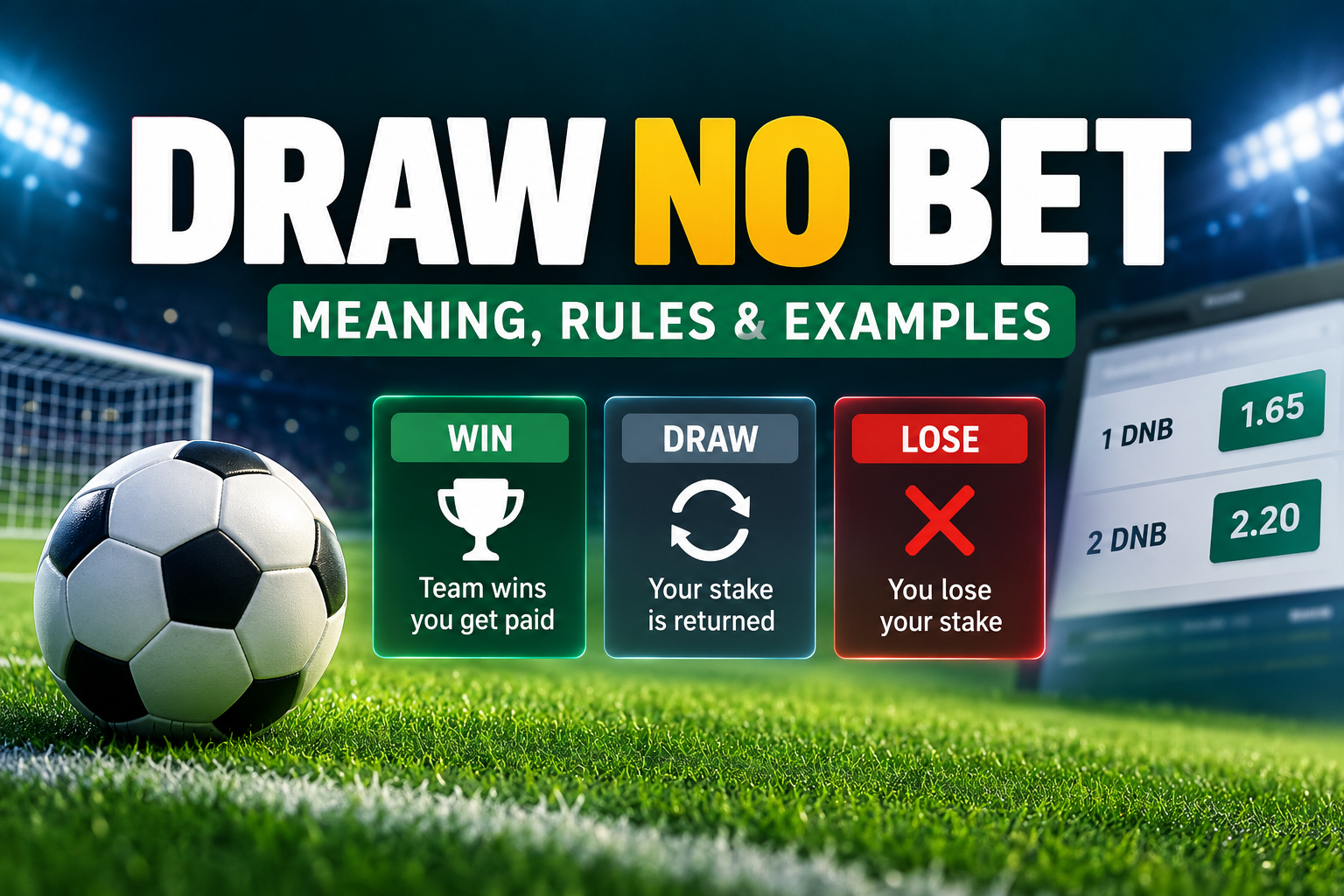
Draw No Bet (DNB) is a football betting market where you select one team to win, but a draw normally returns your original stake. When your selected team wins, the bet pays at the stated odds. By contrast, a level score triggers a refund. If your team loses, however, the stake is lost. For example, suppose Enyimba host Rivers United in a Nigerian Premier Football League fixture. Next, you select Enyimba Draw No Bet at hypothetical odds of 1.65 and stake ₦5,000. In that case, an Enyimba victory returns ₦8,250, including your stake. By comparison, a draw returns ₦5,000, while a Rivers United victory loses the stake. Unlike a normal home-win bet, DNB does not treat a qualifying draw as a loss. Nevertheless, this protection comes with a trade-off: the odds are generally lower than a standard win selection for the same team. This guide explains Draw No Bet meaning in Nigeria, how home and away DNB work, how refunds affect accumulators, how to calculate fair odds, and why a bet with draw protection can still be poor value.
Draw No Bet Meaning: How Does DNB Work?
Draw No Bet removes the draw as a losing outcome for a bet on one selected team. As a result, your selection can have three settlement results: win, refund or loss.
| Result of selected team | DNB settlement | Financial outcome |
|---|---|---|
| Wins | Winning bet | Stake multiplied by decimal odds |
| Draws | Void/refund | Original stake normally returned |
| Loses | Losing bet | Original stake lost |
The important distinction is between a winning bet and a refunded bet. A draw does not usually earn profit on a DNB selection. Instead, the bookmaker cancels that selection for settlement purposes and returns the stake. For example, a ₦3,000 stake at 1.80 produces ₦5,400 if the chosen team wins. However, a 1-1 draw normally returns only ₦3,000. The refund does not include the profit that would have been earned from a victory. In football, standard DNB markets generally use the result after 90 minutes plus stoppage time. Therefore, a team winning after extra time does not necessarily mean a standard full-time DNB selection wins. If you are learning football betting terminology, the 8XBET sports betting guide for Nigeria explains how decimal odds, match-result markets and betting slips work.
What Does 1 DNB and 2 DNB Mean?
Most bookmakers display Draw No Bet with two possible team selections. Specifically, one refers to the home team, while the other refers to the away team.
What Does 1 DNB Mean?
1 DNB means Home Draw No Bet. You are selecting the home team to win, with a draw normally resulting in a refund. Imagine Arsenal host Chelsea. If you select Arsenal 1 DNB, the following scores produce different results:
| Arsenal vs Chelsea | Arsenal 1 DNB | Explanation |
|---|---|---|
| 2-0 | Win | Arsenal win |
| 1-0 | Win | Arsenal win |
| 1-1 | Refund | Match drawn |
| 0-0 | Refund | Match drawn |
| 0-1 | Lose | Chelsea win |
| 1-2 | Lose | Chelsea win |
Therefore, the number 1 refers to the home team. In other words, the home team does not need to win by exactly one goal.
What Does 2 DNB Mean?
2 DNB means Away Draw No Bet. In this case, your selected away team must win for the bet to produce a normal winning payout. For example, suppose Manchester City host Liverpool. If you select Liverpool 2 DNB, a 1-2 Liverpool victory wins. Meanwhile, a 0-0 or 2-2 draw normally returns the stake. By contrast, a 2-0 Manchester City victory makes the bet lose. The number 2 refers to the away team, not the number of goals that team must score.
Does DNB Cover Both Teams?
No. Instead, a DNB selection backs one specific team. Although a draw normally triggers a refund, a victory by the opposing team causes a loss. This differs from Double Chance 12, where either team’s victory is covered but a draw loses.
Draw No Bet Results: Complete Home and Away Settlement Table
The following table shows how home DNB and away DNB settle across common football scores. All examples assume a standard full-time market.
| Final score (home–away) | Home DNB | Away DNB |
|---|---|---|
| 0-0 | Refund | Refund |
| 1-0 | Win | Lose |
| 0-1 | Lose | Win |
| 1-1 | Refund | Refund |
| 2-0 | Win | Lose |
| 0-2 | Lose | Win |
| 2-1 | Win | Lose |
| 1-2 | Lose | Win |
| 2-2 | Refund | Refund |
| 3-0 | Win | Lose |
| 0-3 | Lose | Win |
| 3-3 | Refund | Refund |
| 4-1 | Win | Lose |
Key finding: Every drawn scoreline produces a refund under standard DNB settlement. Meanwhile, every home victory wins home DNB, and every away victory wins away DNB. In other words, the number of goals is not itself the deciding factor. Instead, settlement depends on which team wins within the stated market period.
How Do Draw No Bet Odds Work?
Draw No Bet odds reflect the bookmaker’s price for a team victory, together with the possibility of a stake refund when the match ends level. Because a draw is refunded rather than lost, DNB generally has lower odds than an ordinary win selection for the same team and match. Consider this hypothetical market:
| Selection | Illustrative decimal odds |
|---|---|
| Home win (1X2) | 2.20 |
| Home Draw No Bet | 1.65 |
| Home or Draw (Double Chance 1X) | 1.40 |
Importantly, these prices are constructed examples, not live bookmaker quotes. A home-win bet at 2.20 offers a higher payout if the home team wins. However, it loses when the match ends in a draw. Home DNB at 1.65 pays less for a home victory, but normally returns the stake when the result is level. Home Double Chance 1X at 1.40 pays on both a home victory and a draw. Consequently, its odds are generally lower than the corresponding DNB price. The market with the highest potential payout is not automatically the market with the best value. Instead, judging value requires a reasonable estimate of the possible match outcomes.
How to Calculate Draw No Bet Winnings in Nigerian Naira
Fortunately, decimal odds make DNB returns straightforward to calculate. For a winning selection: Total return = Stake × Decimal odds Net profit = Total return − Stake For a qualifying draw: Refund = Original stake For a losing selection: Return = ₦0
Example: ₦5,000 on Home DNB at 1.65
For this example, suppose you select Enyimba Draw No Bet at 1.65. If Enyimba win, your return is: ₦5,000 × 1.65 = ₦8,250 Your profit is: ₦8,250 − ₦5,000 = ₦3,250 However, if the match finishes 1-1, the selection is normally void. Therefore, your ₦5,000 stake is refunded, and your profit is ₦0. By contrast, an Enyimba defeat returns ₦0, meaning you lose the ₦5,000 stake.
Draw No Bet Returns Calculator Table
| Stake | Odds | Return if win | Net profit | Refund if draw |
|---|---|---|---|---|
| ₦500 | 1.40 | ₦700 | ₦200 | ₦500 |
| ₦1,000 | 1.60 | ₦1,600 | ₦600 | ₦1,000 |
| ₦2,000 | 1.75 | ₦3,500 | ₦1,500 | ₦2,000 |
| ₦3,000 | 1.90 | ₦5,700 | ₦2,700 | ₦3,000 |
| ₦5,000 | 2.10 | ₦10,500 | ₦5,500 | ₦5,000 |
| ₦10,000 | 1.55 | ₦15,500 | ₦5,500 | ₦10,000 |
Importantly, these examples show potential settlement amounts, not guaranteed earnings. Importantly, the winning return includes the original stake. A ₦10,500 return from a ₦5,000 stake means ₦5,500 profit, not ₦10,500 profit.
How to Calculate Fair Draw No Bet Odds From Match Probabilities
To understand DNB more fully, distinguish bookmaker prices from mathematical estimates. Unlike a standard two-outcome bet, DNB has a third possibility: the draw refunds your stake. Therefore, its fair odds depend on the chance of winning relative to the chance of losing, after excluding the draw. For a selected home team, a simple fair-odds formula is: Fair DNB decimal odds = 1 + (Probability of home loss ÷ Probability of home win) Equivalently: Fair DNB decimal odds = (1 − Probability of draw) ÷ Probability of home win For these formulas to apply, the probabilities must add to 100%, and a draw must return the full stake.
Example: Home Win 45%, Draw 30%, Away Win 25%
Imagine your estimated probabilities are:
| Possible result | Estimated probability |
|---|---|
| Home win | 45% |
| Draw | 30% |
| Away win | 25% |
| Total | 100% |
For home DNB: Fair odds = (1 − 0.30) ÷ 0.45 Fair odds = 0.70 ÷ 0.45 Estimated fair home DNB odds = 1.56 For away DNB: Fair odds = (1 − 0.30) ÷ 0.25 Fair odds = 0.70 ÷ 0.25 Estimated fair away DNB odds = 2.80 Importantly, these are mathematical prices based on assumed probabilities. They are not predictions or available bookmaker odds.
Why the Draw Probability Still Matters
A draw does not produce a DNB profit or loss under normal settlement. However, its probability still matters because it determines how often the stake may be refunded. For example, imagine two fixtures with the same estimated home-win probability of 40%.
| Fixture | Home win | Draw | Away win | Fair home DNB odds |
|---|---|---|---|---|
| Match A | 40% | 20% | 40% | 2.00 |
| Match B | 40% | 35% | 25% | 1.63 |
Both home teams have the same estimated chance of winning. Nevertheless, Match B has a higher draw probability and a lower away-win probability. As a result, home DNB is priced differently because the balance between winning and losing outcomes changes. Consequently, simply comparing teams’ win percentages does not provide enough information to evaluate DNB odds.
What Is the Break-Even Probability for Draw No Bet?
A DNB price can be expressed as a required winning share among matches that do not finish in a draw. For decimal odds (O): Required win share among non-draw results = 1 ÷ O For example, at odds of 1.60: 1 ÷ 1.60 = 62.5% However, this does not mean the team must have a 62.5% chance of winning across all matches. Instead, it means the team needs to win more than 62.5% of the outcomes that are not draws for positive expected value, assuming the probability estimates are accurate. Suppose the draw probability is 30%. As a result, the non-draw probability is 70%. The corresponding break-even overall win probability is: 70% ÷ 1.60 = 43.75% At this threshold, the remaining non-draw probability represents losses, while draws produce refunds.
DNB Break-Even Reference Table
| DNB decimal odds | Required win share among non-draw results |
|---|---|
| 1.20 | 83.33% |
| 1.40 | 71.43% |
| 1.50 | 66.67% |
| 1.60 | 62.50% |
| 1.75 | 57.14% |
| 1.80 | 55.56% |
| 2.00 | 50.00% |
| 2.50 | 40.00% |
Importantly, this table describes mathematical break-even conditions. It does not estimate the probability of any actual football fixture.
Draw No Bet Expected Value: Why a Refund Does Not Guarantee Profit
In simple terms, expected value (EV) estimates the average profit or loss of a selection across many hypothetical repetitions, assuming your probabilities are correct. For DNB: EV per ₦1 staked = P(win) × (decimal odds − 1) − P(loss) By contrast, a qualifying draw contributes zero profit because the stake is returned. Consider the earlier example:
- Estimated home-win probability: 45%
- Estimated draw probability: 30%
- Estimated home-loss probability: 25%
- Available illustrative home DNB odds: 1.60
Expected Value = 0.45 × (1.60 − 1) − 0.25 Output Value = 0.45 × 0.60 − 0.25 EV = 0.27 − 0.25 EV = +0.02 per ₦1 staked, or +2% of stake For a ₦5,000 stake, the mathematical expected profit would be ₦100 under those assumptions. However, expected profit is not guaranteed profit. After all, one actual match produces one settlement result: win, refund or loss. Furthermore, inaccurate probability estimates can turn an apparently favourable selection into a losing proposition. For comparison, suppose the offered odds are only 1.45: EV = 0.45 × 0.45 − 0.25 EV = −0.0475 Consequently, that represents an expected loss of 4.75% of stake under the same assumed probabilities. Therefore, the same match can appear favourable or unfavourable depending on the price. This explains why DNB’s refund feature alone cannot establish whether a bet has value.
How Bookmaker Margin Affects Draw No Bet Odds
Bookmakers generally include a margin in their prices. As a result, offered odds are not necessarily equal to mathematical fair odds. For example, consider a hypothetical two-selection DNB market:
| Selection | Offered odds | Raw reciprocal |
|---|---|---|
| Home DNB | 1.70 | 58.82% |
| Away DNB | 2.20 | 45.45% |
| Combined | — | 104.27% |
The combined reciprocal values exceed 100%. In a simplified two-outcome comparison, the excess indicates a margin built into the offered prices. However, these reciprocals represent the market’s conditional pricing among non-draw outcomes, not each team’s unconditional chance of winning the match. A simple proportional adjustment gives:
- Home conditional share: approximately 56.41%
- Away conditional share: approximately 43.59%
Even so, these figures still do not tell you how likely the match is to finish in a draw. Therefore, estimating full match-result probabilities requires a separate draw-probability estimate or additional market information. Important distinction: DNB pricing cannot be interpreted in exactly the same way as a standard 1X2 market without accounting for the draw-refund condition.
Draw No Bet vs Double Chance: Which Market Covers a Draw?
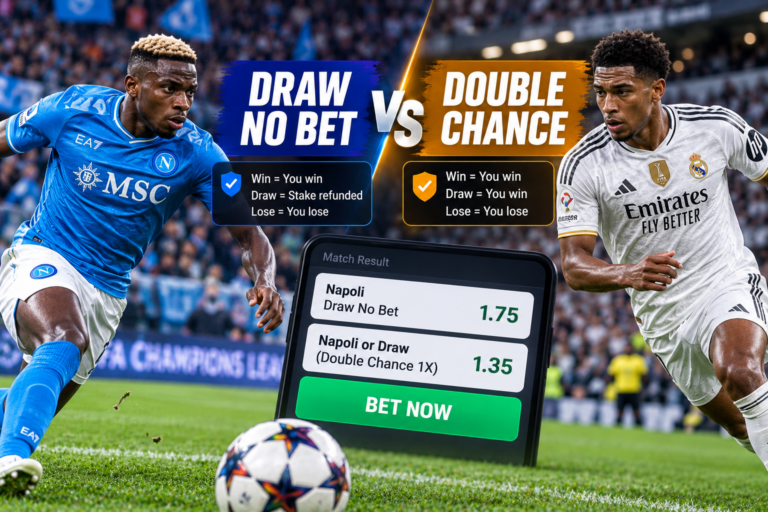
Although both markets change how a draw affects your selection, they do so in different ways. Under home DNB, a draw normally returns your stake. By contrast, home Double Chance 1X treats a draw as a winning result.
| Match result | Home DNB | Double Chance 1X |
|---|---|---|
| Home win | Win | Win |
| Draw | Refund | Win |
| Away win | Lose | Lose |
For example, suppose you compare two hypothetical selections using the same ₦5,000 stake:
- Home DNB at 1.65
- Home 1X at 1.35
For a home victory, DNB returns ₦8,250, while 1X returns ₦6,750. On the other hand, a draw refunds ₦5,000 on DNB, while 1X returns ₦6,750. Finally, an away victory makes both selections lose. Therefore, DNB provides a different payout structure rather than simply being a more profitable version of Double Chance.
Draw No Bet vs X2
Away DNB and Double Chance X2 follow the same distinction. Away DNB wins only when the away team wins and normally refunds a draw. In contrast, X2 wins when the away team wins or the match finishes level. For a full explanation of all three Double Chance markets, including 1X, X2 and 12, read the Double Chance Betting Nigeria guide.
Is DNB the Same as Double Chance 12?
No. Double Chance 12 generally covers either team winning, while a draw loses. DNB backs one team. Consequently, a draw normally produces a refund, while a victory by the opposing team produces a loss. Despite similar-looking market labels on some betting platforms, these are different settlement structures.
Draw No Bet vs 1X2: What Changes When You Remove the Draw?
In contrast to DNB, a standard 1X2 bet requires one exact match-result category to occur: home win, draw or away win. For example, if you select home win at odds of 2.20, the home team must win. A draw loses the bet, even if the home team was the stronger side for most of the match. Home DNB changes the settlement of that drawn result. Instead of losing, the selection normally becomes void and returns the stake.
| Feature | Standard home win | Home DNB |
|---|---|---|
| Home victory | Win | Win |
| Draw | Lose | Refund |
| Away victory | Lose | Lose |
| Typical winning odds | Higher | Lower |
| Draw protection | No | Yes |
| Guaranteed profit | No | No |
The odds difference reflects the altered settlement conditions. Therefore, comparing the two markets requires more than checking which one pays the larger amount.
Draw No Bet vs Asian Handicap 0: Are They Equivalent?
Home Draw No Bet and home Asian Handicap 0 generally have equivalent settlement outcomes for the same team and period. Asian Handicap 0 applies a zero-goal adjustment to the selected team’s result. Since no goals are added or removed, a victory wins, a draw normally refunds and a defeat loses. For example:
| Final score | Home DNB | Home Asian Handicap 0 |
|---|---|---|
| 2-0 | Win | Win |
| 1-1 | Refund | Refund |
| 0-1 | Lose | Lose |
However, other Asian Handicap lines work differently. A home +0.5 selection generally wins when the home team wins or draws. Meanwhile, a +0.25 handicap can produce a half-win or half-loss depending on the score and selection. Therefore, only the zero-handicap line should normally be compared directly with DNB. Always confirm the bookmaker’s market rules.
Does Draw No Bet Include Extra Time and Penalties?
Standard full-time football DNB normally settles using 90 minutes plus stoppage time, excluding extra time and penalties. For example, this matters in knockout competitions, where a match can finish level after regulation time but later produce a winner.
Example: Cup Match Drawn After 90 Minutes
Suppose a cup match produces these scores:
| Match stage | Score |
|---|---|
| End of 90 minutes | 1-1 |
| End of extra time | 2-1 |
| Team progressing | Home team |
A standard 90-minute home DNB selection normally receives a refund because the regulation-time result was a draw. Although the home team eventually wins the tie, that later victory does not change the settlement of the original 90-minute market. However, a separately labelled qualification or extra-time market can use different rules. Therefore, the market description on the ticket takes priority.
How Does Draw No Bet Work in an Accumulator?
In addition, a Draw No Bet selection can be included in an accumulator, also called an acca or multiple bet. When a DNB leg finishes in a qualifying draw, it is normally void. Under standard accumulator settlement, its decimal odds are replaced with 1.00, and the remaining legs continue.
Example: Four-Leg Accumulator With One DNB Draw
Imagine a ₦2,000 accumulator with these hypothetical selections:
| Leg | Odds | Result |
|---|---|---|
| Home DNB | 1.60 | Draw — void |
| Away win | 1.80 | Win |
| Over 1.5 goals | 1.50 | Win |
| Home win | 1.40 | Win |
Before settlement, the combined odds are: 1.60 × 1.80 × 1.50 × 1.40 = 6.048 If every leg had won, the potential total return would have been: ₦2,000 × 6.048 = ₦12,096 However, the DNB leg finished in a draw. Consequently, that leg becomes 1.00: 1.00 × 1.80 × 1.50 × 1.40 = 3.78 The revised total return is: ₦2,000 × 3.78 = ₦7,560 Net profit = ₦7,560 − ₦2,000 = ₦5,560 As a result, the accumulator still wins because the remaining active legs won. Nevertheless, its total payout is lower than originally calculated.
What if the Other Accumulator Legs Lose?
However, a void DNB leg does not protect the remaining selections. For example, if the DNB leg draws but another active leg loses, the accumulator normally loses under standard multiple-bet rules.
What if Every Leg Is Void?
When every selection becomes void, the original stake is normally refunded. However, free bets, bonuses and promotional tickets may follow separate terms. Therefore, always check the rules attached to the actual ticket.
Can Draw No Bet Apply to First-Half or Second-Half Betting?
Yes. For example, some bookmakers offer DNB markets for specific match periods rather than the full 90 minutes. For example, a First Half Draw No Bet selection uses only the score at half-time. Suppose the home team trails 0-1 at half-time but eventually wins 2-1. A home First Half DNB selection loses because the home team was behind at the end of the first half. However, a home Full Time DNB selection wins because the home team won the match.
| Half-time score | Full-time score | Home first-half DNB | Home full-time DNB |
|---|---|---|---|
| 0-0 | 2-1 | Refund | Win |
| 1-0 | 1-1 | Win | Refund |
| 0-1 | 2-1 | Lose | Win |
| 1-1 | 1-2 | Refund | Lose |
As a result, the same fixture can produce different settlements depending on the period selected. Always check whether the betting slip states First Half, Second Half or Full Time.
Why Was My Draw No Bet Selection Voided or Refunded?
Depending on the event, a DNB selection may be marked void for several reasons. Understanding the reason helps distinguish normal settlement from an event-related cancellation.
The Match Finished in a Draw
First, this is the standard DNB refund condition. If the match ends level during the specified settlement period, the original stake is normally returned.
The Match Was Postponed
Similarly, a postponed fixture may be voided if it is not played within the period allowed by the bookmaker’s rules. However, different operators apply different deadlines. Therefore, the same postponement does not necessarily produce identical settlement across every platform.
The Match Was Abandoned
Likewise, an abandoned match may trigger a void or another settlement outcome depending on the market, elapsed time and bookmaker rules. For this reason, do not assume every abandoned football match automatically produces a refund.
The Market Was Cancelled or Settled Under Special Rules
Finally, a bookmaker may cancel a market or apply specific event rules. If the settlement seems incorrect, compare the exact market label, official result and operator rules before contacting support.
What Should Nigerian Readers Check Before Comparing DNB Odds?
In practice, DNB prices vary across teams, competitions and bookmakers. However, comparing prices only makes sense when the underlying markets are identical.
Check Home and Away Performance Separately
A team can have strong overall league form but weak away results. Therefore, home and away records may provide more relevant context than total points alone. Nevertheless, past results cannot establish what will happen in the next fixture.
Consider Draw Frequency Without Treating It as a Prediction
A team’s recent draw record may help describe previous match patterns. However, a run of draws does not prove another draw is due. A useful analysis considers opponent strength, playing conditions and match context rather than relying on streaks alone.
Check Injuries, Suspensions and Starting Lineups
In addition, missing players can affect how a team performs. For example, the absence of a first-choice goalkeeper or central defender may change the balance of a fixture. However, even confirmed lineups do not guarantee any particular result.
Compare Identical Settlement Periods
For instance, a full-time DNB market is not directly comparable with a first-half DNB market. Similarly, a qualification market may include extra time or penalties while standard full-time DNB excludes them.
Compare Prices, Not Just Team Names
Suppose two bookmakers offer the same home DNB market:
| Bookmaker | Hypothetical odds | Return on ₦5,000 win |
|---|---|---|
| A | 1.60 | ₦8,000 |
| B | 1.70 | ₦8,500 |
Bookmaker B offers ₦500 more total return if the selection wins, assuming identical rules and no additional charges. However, neither price proves the selection has positive expected value. That depends on the actual probabilities, which remain uncertain.
Draw No Bet and Goal Markets: What Is the Difference?
Draw No Bet concerns which team wins. By contrast, goal markets concern how many goals are scored or whether both teams score. For example, a home DNB selection can win 1-0, 2-0 or 3-2. Therefore, the winning margin does not matter. Meanwhile, Over 2.5 Goals requires at least three total goals in the specified period. Consider these results:
| Score | Home DNB | Over 2.5 goals |
|---|---|---|
| 1-0 | Win | Lose |
| 2-0 | Win | Lose |
| 2-1 | Win | Win |
| 1-1 | Refund | Lose |
| 1-2 | Lose | Win |
| 0-0 | Refund | Lose |
Therefore, a home DNB selection and an Over 2.5 Goals selection can settle differently even on the same match. For detailed goal-line explanations, see the Over and Under Goals Betting Nigeria guide.
Common Draw No Bet Mistakes and How to Avoid Them
Mistake 1: Assuming a Draw Produces Profit
A draw normally returns the stake. In other words, it does not produce the winning payout shown by the DNB odds.
Mistake 2: Confusing DNB With Double Chance
Double Chance 1X and X2 treat draws as winning outcomes. In contrast, DNB normally refunds them.
Mistake 3: Believing DNB Eliminates Risk
DNB protects against one result: a qualifying draw. However, a defeat for the selected team still loses the full stake.
Mistake 4: Ignoring the Settlement Period
A team may win after extra time while its standard 90-minute DNB selection is refunded. Therefore, always confirm the market period.
Mistake 5: Treating Short Odds as Evidence of Value
A low price can correspond to a relatively likely result, but it may still be poor value. Consequently, odds should not be interpreted as proof that a selection is worthwhile.
Mistake 6: Misreading an Accumulator Refund
A void DNB leg normally becomes 1.00 in an accumulator. However, it does not turn the entire ticket into an automatic winner.
Mistake 7: Confusing Total Return With Net Profit
A ₦5,000 winning stake at 1.60 returns ₦8,000 in total. However, net profit is only ₦3,000.
Mistake 8: Assuming Probability Estimates Are Facts
Importantly, football probabilities are estimates, not certainties. Even a mathematically favourable selection can lose, while a weak probability model can make a poor price appear attractive.
Draw No Bet: Key Facts at a Glance
| Question | Answer |
|---|---|
| What does DNB stand for? | Draw No Bet |
| What does 1 DNB mean? | Home team Draw No Bet |
| What does 2 DNB mean? | Away team Draw No Bet |
| What happens if selected team wins? | Winning payout at stated odds |
| What happens if match draws? | Original stake normally refunded |
| What happens if selected team loses? | Stake lost |
| Does 0-0 refund DNB? | Yes, under standard settlement |
| Does DNB include extra time? | Normally no, unless specified |
| What happens to a void DNB accumulator leg? | Odds normally become 1.00 |
| Is DNB equivalent to Asian Handicap 0? | Generally yes, for same team and period |
| Is DNB the same as Double Chance? | No |
| Does DNB guarantee profit? | No |
Frequently Asked Questions About Draw No Bet
Draw No Bet Meaning and Results
What does Draw No Bet mean in football betting?
Draw No Bet (DNB) means selecting one team to win while a qualifying draw normally returns the original stake. If the selected team wins, the bet pays at the quoted odds. However, if the selected team loses, the stake is lost.What does 1 DNB mean?
1 DNB means Home Draw No Bet. For a winning payout, the home team must win. Meanwhile, a draw normally produces a refund, while an away victory causes the bet to lose.What does 2 DNB mean?
2 DNB means Away Draw No Bet. For a winning payout, the away team must win. Meanwhile, a draw normally returns the original stake, while a home victory causes the bet to lose.Does Draw No Bet refund a 0-0 match?
Yes. A 0-0 score is a draw. Therefore, a standard full-time DNB selection is normally refunded regardless of whether the home or away team was selected.Odds, Returns and Market Differences
Is Draw No Bet the same as Double Chance?
No. Draw No Bet normally refunds a qualifying draw. In contrast, Double Chance 1X or X2 counts a draw as a winning outcome. Consequently, the markets have different odds and settlement rules.Is Draw No Bet the same as Asian Handicap 0?
Generally, yes, when both markets cover the same team and settlement period. A selected-team victory wins, a draw normally refunds and a defeat loses. However, always check the bookmaker’s rules.How do I calculate DNB winnings in naira?
Multiply the stake by the decimal odds to calculate total return. For example, a ₦2,000 winning DNB selection at 1.75 returns ₦3,500, including the original stake. Net profit is therefore ₦1,500. A qualifying draw normally returns only ₦2,000.How do I calculate fair Draw No Bet odds?
For home DNB, one fair-odds formula is (1 − draw probability) divided by home-win probability. For example, with a 45% home-win probability and a 30% draw probability, estimated fair home DNB odds are approximately 1.56. However, the result depends on the accuracy of those probability estimates.Accumulators, Refunds and Extra Time
What happens to Draw No Bet in an accumulator?
When a DNB accumulator leg finishes in a qualifying draw, that leg is normally void and its odds become 1.00. The remaining legs continue. Therefore, the combined odds and potential payout are recalculated using the active selections.Does Draw No Bet include extra time?
Standard full-time DNB normally settles after 90 minutes plus stoppage time. Extra time and penalties are generally excluded. However, specially labelled markets may have different settlement periods.Can Draw No Bet guarantee profit?
No. Draw No Bet does not guarantee profit. Although a qualifying draw normally returns the original stake, a defeat for the selected team loses the bet. Consequently, the full stake remains at risk.Understanding Draw No Bet in Nigeria
Overall, Draw No Bet offers a different settlement structure from ordinary match-win betting. Instead of losing when the selected match finishes level, the original stake is normally refunded. The basic rule is simple: your team wins, the bet wins; the match draws, the stake returns; your team loses, the bet loses. However, understanding the market requires more than remembering that rule. Decimal odds determine winning payouts, bookmaker margins affect prices, and accumulator refunds change combined odds. Furthermore, standard 90-minute settlement may differ from extra-time or qualification markets. For readers comparing DNB with other football markets, the most useful questions are whether the draw is refunded or paid as a win, which period the market covers, and whether the offered odds fairly reflect the estimated outcomes. Explore more football betting explanations at 8xbet9ja. Responsible gambling: Betting involves financial risk. Participate only where legally permitted and if you meet the minimum age requirement. Set firm spending limits, never chase losses and do not treat betting as income. Seek appropriate support if gambling becomes difficult to control.