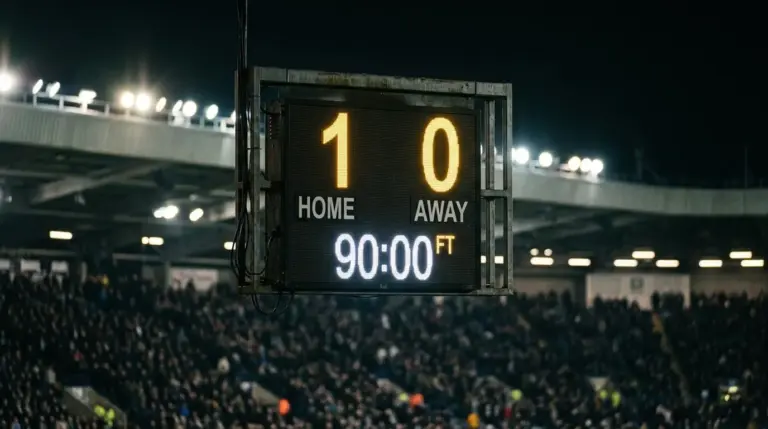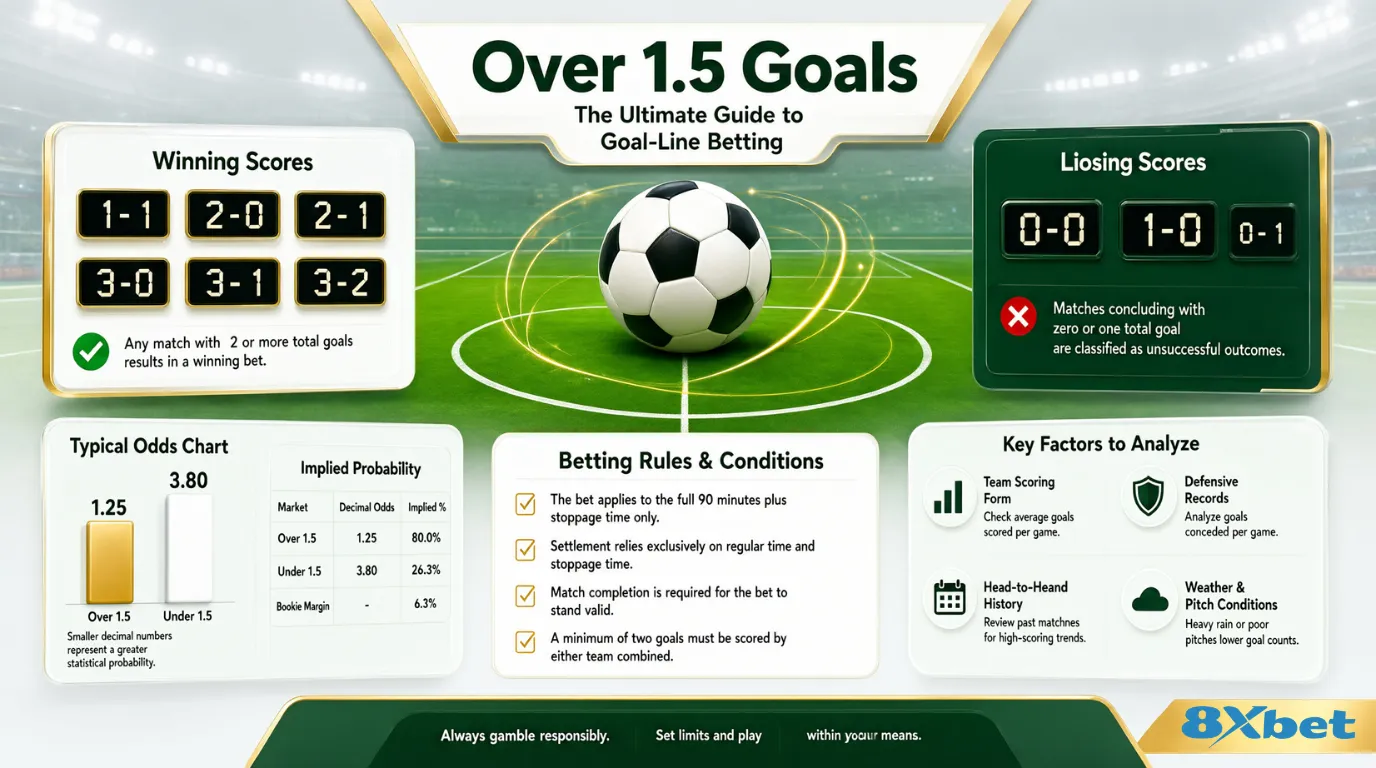
The Over 1.5 goals meaning in football betting is that a match must produce at least two combined goals for the selection to win. Either team can score, and the goals do not need to come from different sides. For example, a 1-1 draw, 2-0 home win or 0-2 away win all satisfy the Over 1.5 requirement.
However, a 1-0 or 0-1 result does not qualify because each scoreline contains only one goal. The important factor is the total number of goals scored by both teams during the period covered by the market.
This guide explains how Over 1.5 goals works, which football scores win or lose, how bookmakers calculate odds and what makes a match suitable for deeper goal-market analysis. It also covers team goals, first-half selections, accumulators, expected goals and the difference between a frequent winning outcome and a genuinely worthwhile price.
Quick answer: Over 1.5 goals wins when a football match produces two or more total goals. It loses when the match finishes 0-0, 1-0 or 0-1. Both teams do not need to score.
What Does Over 1.5 Goals Mean in Football Betting?
Over 1.5 is a total-goals market. It measures the combined goals scored by the home and away teams rather than predicting which team will win.
The bookmaker sets a goal line at 1.5, and you select Over or Under depending on the expected match total.
The half-goal number separates the possible results. Football matches produce whole goals, so the final score cannot contain exactly 1.5 goals.
For Over 1.5 to win, the combined total must reach at least two.
Consider these hypothetical results:
- Arsenal 1-1 Chelsea: Over 1.5 wins.
- Barcelona 2-0 Sevilla: Over 1.5 wins.
- Inter Milan 0-2 Juventus: Over 1.5 wins.
- Liverpool 2-1 Tottenham: Over 1.5 wins.
- AC Milan 1-0 Roma: Over 1.5 loses.
- Bayern Munich 0-1 Dortmund: Over 1.5 loses.
- Napoli 0-0 Atalanta: Over 1.5 loses.
These examples demonstrate an important point: the winning team does not matter. Only the combined number of goals determines the settlement.
Over 1.5 Goals: Winning and Losing Score Examples
Understanding the qualifying scorelines makes it easier to interpret Over 1.5 on a Nigerian betting slip.
Which Scores Win Over 1.5?
Any applicable final score containing at least two total goals wins.
| Final score | Total goals | Over 1.5 result |
|---|---|---|
| 1-1 | 2 | Win |
| 2-0 | 2 | Win |
| 0-2 | 2 | Win |
| 2-1 | 3 | Win |
| 1-2 | 3 | Win |
| 3-0 | 3 | Win |
| 0-3 | 3 | Win |
| 2-2 | 4 | Win |
| 3-1 | 4 | Win |
| 3-2 | 5 | Win |
| 4-1 | 5 | Win |
Which Scores Lose Over 1.5?
A match that produces zero or one combined goal loses the selection.
| Final score | Total goals | Over 1.5 result |
|---|---|---|
| 0-0 | 0 | Lose |
| 1-0 | 1 | Lose |
| 0-1 | 1 | Lose |
The distinction is simple: two or more goals win; zero or one goal loses.
Does Over 1.5 Require Both Teams to Score?
No. Both teams do not need to score for Over 1.5 to win.
A single team can provide both goals.
For example:
- 2-0: The home team scores twice.
- 0-2: The away team scores twice.
- 3-0: The home team scores three times.
- 0-3: The away team scores three times.
All four results satisfy Over 1.5.
This is different from Both Teams to Score (BTTS), where each team must score at least once.
For example:
| Final score | Over 1.5 | BTTS Yes |
|---|---|---|
| 2-0 | Win | Lose |
| 0-2 | Win | Lose |
| 1-1 | Win | Win |
| 2-1 | Win | Win |
| 1-0 | Lose | Lose |
| 0-0 | Lose | Lose |
Therefore, a match can produce enough goals for Over 1.5 without satisfying BTTS.
For a detailed explanation of both markets, visit our BTTS vs Over 2.5 goals guide.
What Does Under 1.5 Goals Mean?
Under 1.5 is the opposite side of the same goal line.
It wins when the match produces zero or one total goal.
Examples include:
- 0-0.
- 1-0.
- 0-1.
However, a 1-1 result loses Under 1.5 because the match contains two goals.
| Final score | Over 1.5 | Under 1.5 |
|---|---|---|
| 0-0 | Lose | Win |
| 1-0 | Lose | Win |
| 0-1 | Lose | Win |
| 1-1 | Win | Lose |
| 2-0 | Win | Lose |
| 0-2 | Win | Lose |
| 2-1 | Win | Lose |
The two selections cover opposite outcomes under standard two-way settlement.
Because 1.5 is a half-goal line, an ordinary match-goals Over 1.5 selection cannot finish exactly on the threshold. Consequently, there is no standard push at 1.5.
What Is the Difference Between Over 0.5, 1.5, 2.5 and 3.5 Goals?
The number attached to an Over/Under selection determines how many goals the match needs.
Each additional half-goal raises the minimum qualifying total by one.
| Goal market | Minimum goals required to win |
|---|---|
| Over 0.5 | 1 |
| Over 1.5 | 2 |
| Over 2.5 | 3 |
| Over 3.5 | 4 |
| Over 4.5 | 5 |
For example:
- Over 0.5 wins with 1-0.
- Over 1.5 wins with 1-1.
- Over 2.5 wins with 2-1.
- Over 3.5 wins with 2-2.
Over 1.5 vs Over 2.5
Over 1.5 requires at least two goals, while Over 2.5 requires at least three.
A 1-1 result wins Over 1.5 but loses Over 2.5.
Similarly, a 2-0 result wins Over 1.5 but does not reach the Over 2.5 threshold.
Over 1.5 vs Over 3.5
Over 3.5 requires four or more goals.
A 2-1 result contains three goals, so it wins Over 1.5 but loses Over 3.5.
The higher goal line therefore covers fewer possible scorelines.
For a wider explanation of these markets, see our Over/Under goals betting guide for Nigeria.
What Does Full-Time Over 1.5 Mean?
Full-Time Over 1.5 goals refers to the combined number of goals during the applicable full-match period.
Under standard football betting terms, this normally means regular playing time, including first-half and second-half stoppage time.
For most ordinary 90-minute markets, extra time and penalty shootouts do not count unless the bookmaker specifies otherwise.
The International Football Association Board’s Law 7 establishes two 45-minute periods and allows the referee to add time for interruptions such as substitutions, injuries, VAR checks and goal celebrations.
This matters when a goal arrives late in the match. A goal scored during second-half stoppage time normally counts towards a standard full-time goals total.
However, a goal scored during extra time in a knockout match normally falls outside the regular-time market.
Always confirm the market description and the operator’s settlement rules.
First-Half Over 1.5 Goals Explained
First-Half Over 1.5 applies the same two-goal threshold to the opening period only.
The teams must score at least two combined goals before the half-time whistle.
For example:
| Half-time score | First-half goals | Over 1.5 first half |
|---|---|---|
| 0-0 | 0 | Lose |
| 1-0 | 1 | Lose |
| 0-1 | 1 | Lose |
| 1-1 | 2 | Win |
| 2-0 | 2 | Win |
| 0-2 | 2 | Win |
| 2-1 | 3 | Win |
A match can finish with four goals and still lose First-Half Over 1.5 if the first period produces only one goal.
For example:
- Half-time: 1-0.
- Full-time: 2-2.
- First-half total: 1.
- Full-time total: 4.
Full-Time Over 1.5 wins, but First-Half Over 1.5 loses.
Do not confuse this market with first-half Over 0.5. The 0.5 line needs one first-half goal, whereas the 1.5 line needs two.
Read our First Half Over 0.5 goals explanation for a more detailed comparison of opening-period markets.
What Is Team Total Over 1.5 Goals?
Team Total Over 1.5 focuses on one team’s goals rather than the combined match total.
The selected team must score at least two goals.
Suppose the market offers Arsenal Team Total Over 1.5.
The selection wins if Arsenal scores twice or more, regardless of Chelsea’s score.
| Arsenal score | Chelsea score | Arsenal Over 1.5 |
|---|---|---|
| 0 | 0 | Lose |
| 1 | 0 | Lose |
| 1 | 1 | Lose |
| 2 | 0 | Win |
| 2 | 1 | Win |
| 3 | 2 | Win |
| 0 | 2 | Lose |
Notice that a 1-1 final result wins Full-Time Over 1.5 but loses Arsenal Team Total Over 1.5.
The combined match total contains two goals, but Arsenal itself has scored only one.
This distinction also applies to Away Team Over 1.5 and other team-specific goal lines.
How Do Over 1.5 Goals Odds Work?
Bookmakers offer decimal odds for Over 1.5 based on the event’s estimated probability, available information and their pricing margin.
Suppose a match has an illustrative Over 1.5 price of 1.30.
You place a ₦2,000 stake.
Calculate the Potential Total Return
The standard formula is:
Total return = Stake × Decimal odds
₦2,000 × 1.30 = ₦2,600.
Calculate the Potential Profit
Net profit = Total return − Original stake
₦2,600 − ₦2,000 = ₦600.
If the match produces zero or one goal, the selection loses and the ₦2,000 stake is lost.
These figures illustrate how decimal odds work. They are not live bookmaker prices.
What Does 1.30 Odds Mean?
You can convert decimal odds into raw implied probability using:
Implied probability = (1 ÷ Decimal odds) × 100
For odds of 1.30:
1 ÷ 1.30 × 100 = 76.92%.
This is the raw probability implied by the quoted price before accounting for the bookmaker’s margin.
It does not prove that the match has a 76.92% chance of producing two goals.
For more information, visit our decimal odds explained guide.
Why Short Over 1.5 Odds Can Still Be Poor Value
Over 1.5 has more qualifying scorelines than Over 2.5 or Over 3.5. As a result, its odds can be relatively short.
However, a frequent winning outcome is not automatically a profitable selection.
The key question is whether the estimated probability is high enough for the available price.
Consider these illustrative prices:
| Decimal odds | Raw implied probability |
|---|---|
| 1.20 | 83.33% |
| 1.25 | 80.00% |
| 1.30 | 76.92% |
| 1.35 | 74.07% |
| 1.40 | 71.43% |
| 1.50 | 66.67% |
| 1.60 | 62.50% |
The shorter the odds, the higher the break-even probability.
For instance, a selection priced at 1.25 needs to win more than 80% of the time to generate a positive long-run return before considering other costs and margin effects.
Suppose your independently estimated probability is only 73%.
At odds of 1.25, the selection can win more often than it loses and still perform poorly financially.
This is why you should compare price and estimated probability rather than selecting a goal line simply because it looks likely.
How One Loss Can Erase Several Small Profits
Imagine placing ten separate bets of ₦1,000 at odds of 1.30.
Each winning selection earns ₦300 profit.
If eight selections win:
8 × ₦300 = ₦2,400 profit.
The two losing selections cost:
2 × ₦1,000 = ₦2,000.
Net result:
₦2,400 − ₦2,000 = ₦400 profit.
However, if only seven selections win:
7 × ₦300 = ₦2,100 profit.
Three losses cost ₦3,000.
Net result:
₦2,100 − ₦3,000 = ₦900 loss.
The example demonstrates why a high win rate alone does not establish a profitable strategy.
How to Analyse Over 1.5 Goals Predictions
Before assessing a fixture, examine whether the teams can create and concede enough quality chances for the combined total to reach two goals.
A strong analysis considers both attacks, both defences and the context of the match.
1. Examine Average Goals Scored
Start with the number of goals each team scores over a consistent sample.
However, do not rely only on full-season averages.
Compare:
- Goals scored per match.
- Goals scored at home.
- Goals scored away.
- First-half and second-half scoring.
- Recent scoring patterns.
- Performance against comparable opposition.
A team that averages two goals per home match may have a very different attacking profile when playing away.
2. Compare Goals Conceded
The opposition’s defensive performance can influence the likelihood of Over 1.5.
Check how frequently each team concedes and whether its defensive performance changes by venue.
For example, an attacking side that averages 1.5 goals per match may still struggle against an opponent that limits high-quality chances.
Conversely, a team with a modest attack may find opportunities against a defence that frequently allows goals.
3. Review Expected Goals (xG) and xGA
Expected goals, commonly called xG, estimates the quality of scoring opportunities.
Expected goals against (xGA) estimates the quality of opportunities a team allows its opponents to create.
These statistics provide more context than final scores alone.
A team might win several matches 1-0 despite producing few high-quality chances. Another side may have several high-xG performances that did not translate into goals because of poor finishing.
For Over 1.5 analysis, examine:
- Home team’s xG.
- Away team’s xG.
- Home team’s xGA.
- Away team’s xGA.
- Recent attacking chance quality.
- Defensive opportunities conceded.
Do not interpret xG as a guaranteed number of future goals. It remains a probability-based estimate whose accuracy depends on the data and modelling method.
4. Examine Failed-to-Score Records
Failed-to-score statistics show how frequently a team finishes without scoring.
A team that regularly fails to score may reduce the number of potential goal combinations, especially when it faces a strong defence.
However, the opponent might score twice by itself.
Therefore, a poor-scoring team’s record does not automatically make Over 1.5 unsuitable.
Consider the attacking strength of both teams and the possibility that one side could produce most of the match’s goals.
5. Compare Home and Away Form
Venue can influence attacking performance.
Some teams create more chances at home, while others become more defensive on the road.
Compare the home team’s home goal statistics with the away team’s away performance.
Also examine how often both teams concede in those situations.
This helps identify whether the fixture has two reasonable scoring routes or relies heavily on one side.
6. Check Team News and Player Availability
An unavailable striker or creative midfielder can affect attacking output.
Likewise, a missing central defender or goalkeeper may change the opposition’s scoring prospects.
Review confirmed starting lineups, relevant suspensions and reliable injury updates.
Avoid treating rumours as confirmed information.
7. Consider Tactical Matchups
Different playing styles create different scoring environments.
Two aggressive teams may produce regular transitions and clear scoring opportunities.
However, a possession-dominant team facing a compact defence may struggle to turn territorial control into goals.
Look at:
- Pressing intensity.
- Defensive line height.
- Counterattacking ability.
- Wide attacking patterns.
- Set-piece threat.
- Defensive organisation.
- Likely match tempo.
The objective is to assess how the two teams’ styles interact, not simply label both clubs attacking or defensive.
8. Consider Competition and Match Context
Goal patterns can differ between domestic leagues, cup competitions and international fixtures.
A league’s general scoring environment provides useful context, but it should not replace individual fixture analysis.
Also consider:
- Competition stage.
- Fixture congestion.
- Rotation risk.
- Motivation.
- Home advantage.
- Travel and recovery time.
- Tactical importance of the result.
Avoid assuming that a particular competition always produces Over 1.5 results. Current team and fixture evidence should support the assessment.
How to Estimate Over 1.5 Probability With a Poisson Model
A Poisson model provides one way to estimate the probability of different football goal totals.
In a simplified model, each team receives an expected goal rate.
For a combined expected total represented by λ, the probability of Over 1.5 can be calculated as:
P(Over 1.5) = 1 − P(0 goals) − P(1 goal)
For a basic Poisson distribution:
P(Over 1.5) = 1 − e⁻λ(1 + λ)
Worked Example
Suppose a hypothetical match has these estimated goals:
| Team | Expected goals |
|---|---|
| Home | 1.40 |
| Away | 1.00 |
| Combined expectation | 2.40 |
The combined expected goal rate is 2.40.
Using the simplified Poisson formula:
P(Over 1.5) = 1 − e⁻²·⁴(1 + 2.4)
P(Over 1.5) ≈ 69.2%.
The model-derived fair decimal price is approximately:
1 ÷ 0.692 = 1.45.
These are hypothetical model inputs, not actual team statistics or predictions for a scheduled fixture.
What Are the Limitations of a Poisson Model?
A basic Poisson model does not capture every element of football.
It may overlook:
- Red cards.
- Injuries during the match.
- Tactical changes.
- Scoreline-dependent behaviour.
- Unusual finishing performance.
- Team-specific match conditions.
Some advanced models also adjust for dependencies between team scoring rates and historical low-score patterns.
Consequently, use a Poisson estimate as one part of your analysis, not as a guaranteed forecast.
Over 1.5 Goals in Live Betting
Over 1.5 is also available as an in-play market on some betting platforms.
Its probability changes as the match progresses.
For example:
First at 0-0 after 20 minutes: Two goals are still required during the remaining match period.
Second at 1-0 after 35 minutes: One additional goal is required.
Third at 1-1 after 60 minutes: The standard full-time Over 1.5 requirement has already been met, so a new in-play market or the original selection may already be settled according to the operator.
Last at 1-0 after 75 minutes: The selection still needs one goal before the relevant match period ends.
Live prices reflect the current score, remaining time, available match data and other events.
However, shots and possession alone do not guarantee goals. A team can dominate the final 15 minutes without scoring.
For that reason, distinguish between the pre-match Over 1.5 market and a new live selection.
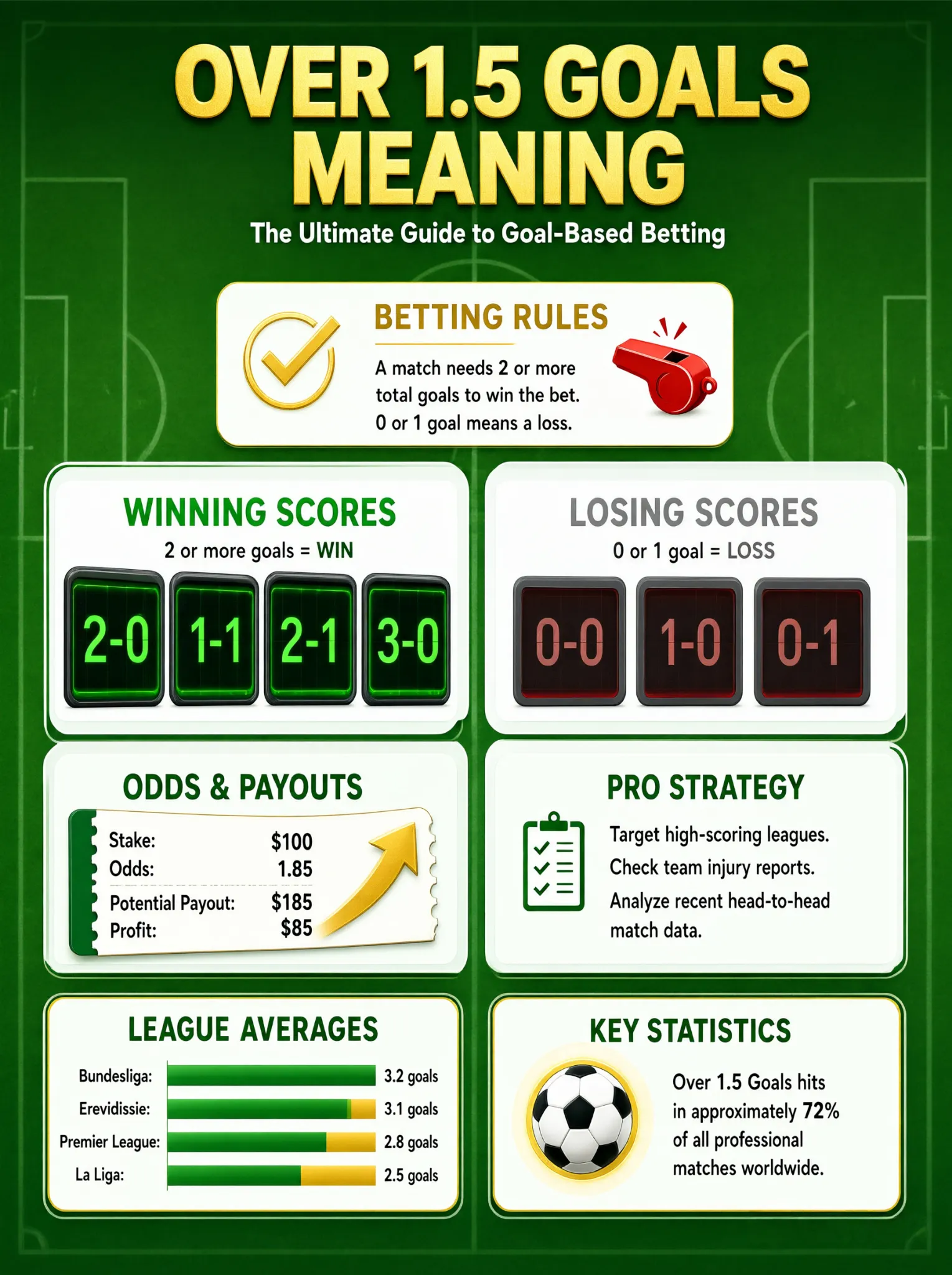
Can You Combine Over 1.5 Goals in an Accumulator?
Yes. Bookmakers may allow Over 1.5 selections from different fixtures to form an accumulator.
However, every active leg needs to win under the applicable rules.
Suppose you select three matches at illustrative odds of 1.30 each.
Combined odds:
1.30 × 1.30 × 1.30 = 2.197.
With a ₦1,000 stake:
Potential total return:
₦1,000 × 2.197 = ₦2,197.
Potential profit:
₦2,197 − ₦1,000 = ₦1,197.
These figures are illustrative rather than live prices.
Why Multiple Over 1.5 Legs Increase Risk
Suppose each of three independent selections has an actual 75% chance of winning.
The probability that all three win is:
0.75 × 0.75 × 0.75 = 42.2%.
Although each individual selection has a relatively high estimated probability, the combined chance of winning the full accumulator falls considerably.
Actual fixtures may not be independent, so this calculation is an illustration rather than a universal accumulator probability.
Adding more legs increases the number of outcomes that must all be correct.
For more detailed return calculations, read our accumulator odds guide for Nigeria.
Over 1.5 vs Other Football Betting Markets
Over 1.5 is closely related to several popular football markets, but each selection measures a different outcome.
| Market | What must happen |
|---|---|
| Over 1.5 | At least two combined goals |
| Under 1.5 | Zero or one combined goal |
| BTTS Yes | Both teams score at least once |
| BTTS No | At least one team fails to score |
| Over 2.5 | At least three combined goals |
| First-Half Over 1.5 | At least two goals before half-time |
| Team Total Over 1.5 | The named team scores at least two goals |
| Correct Score | The exact final score must match |
This distinction matters because a prediction for one market cannot automatically support another.
For example, a 2-0 result wins Over 1.5 and BTTS No. Meanwhile, a 1-1 result wins Over 1.5 and BTTS Yes.
The same match can therefore satisfy different goal-market combinations depending on the final score.
Where to Find Fixtures and Research Over 1.5 Matches
Before analysing a fixture, confirm the teams, competition, kickoff time and match status.
You can use BallsFC’s football matches today to review upcoming fixtures and competition schedules.
When a game starts, BallsFC live football scores helps you follow current scorelines and match status.
After the final whistle, BallsFC finished football results provides completed scores for checking outcomes.
For additional Over 1.5 market analysis, read Xtabet’s Over 1.5 goals betting guide. It offers further discussion of goal probabilities, price evaluation and the difference between a high hit rate and betting value.
These resources support different parts of match research. However, always check the bookmaker’s own market wording and quoted price before interpreting or placing a selection.
For wider pre-match analysis, visit the 8XBET9JA football predictions today hub.
Common Mistakes When Analysing Over 1.5 Goals
Assuming Every Favourable Fixture Will Produce Two Goals
A strong attacking reputation does not guarantee goals. Assess actual opportunities, opposition strength and current team performance.
Confusing Over 1.5 With BTTS
Both teams do not need to score. A 2-0 result satisfies Over 1.5 even though BTTS Yes loses.
Relying Only on Recent Results
A short winning streak can hide poor chance creation or unusually high finishing rates.
Compare recent form with the full-season record and quality of opposition.
Ignoring the Available Price
A selection can have a relatively high probability and still offer poor value when the bookmaker’s odds are too short.
Compare the quoted price with a realistic probability estimate.
Using Full-Time Data for First-Half Predictions
A team can score frequently after half-time without producing many early goals.
Use first-half-specific statistics when analysing first-half markets.
Adding Too Many Selections to an Accumulator
Each additional leg introduces another condition that must be satisfied. A long list of short-priced Over 1.5 selections does not eliminate risk.
Ignoring Team News
Missing forwards, defensive injuries and unexpected rotations can change the scoring outlook.
Check reliable information before relying on an earlier assessment.
Confusing Match Goals With Team Goals
A 1-1 result wins match Over 1.5 but does not satisfy either team’s individual Over 1.5 requirement.
Always read the complete market title.
Frequently Asked Questions About Over 1.5 Goals
Basic Meaning and Winning Scores
What does Over 1.5 goals mean in football betting?
Over 1.5 means a football match must produce at least two combined goals for the selection to win. Either team can score, and both teams do not need to find the net.
Does 1-0 win Over 1.5?
No. A 1-0 score contains only one goal, so it does not reach the required total of two.
Does 2-0 win Over 1.5?
Yes. A 2-0 result contains two goals, so it qualifies even though only the home team scores.
Does 1-1 win Over 1.5?
Yes. Both teams score once, producing two combined goals. The selection wins.
Does Over 1.5 mean two goals from each team?
No. It requires two goals in total, not two goals from each team. A 2-0, 0-2 or 1-1 result all qualify.
Under 1.5 and Other Goal Markets
What does Under 1.5 goals mean?
Under 1.5 means the match must produce zero or one combined goal. Results such as 0-0, 1-0 and 0-1 satisfy the selection.
What is the difference between Over 1.5 and Over 2.5?
Over 1.5 needs at least two total goals, while Over 2.5 needs at least three. A 1-1 result wins Over 1.5 but loses Over 2.5.
Is Over 1.5 the same as BTTS?
No. Over 1.5 requires two combined goals, while BTTS Yes requires each team to score. A 2-0 result wins Over 1.5 but loses BTTS Yes.
What does Team Total Over 1.5 mean?
It means the selected team must score at least two goals. The opposition’s goals do not count towards that team’s individual total.
Timing, Odds and Settlement
Does Over 1.5 include extra time?
Standard full-time football goals markets generally cover regular playing time and applicable stoppage time. Extra time and penalty shootouts normally remain excluded unless the operator explicitly states otherwise.
Does a goal in stoppage time count for Over 1.5?
Yes. A goal scored during applicable second-half stoppage time normally counts towards the regular-time match total, provided the referee awards it before the final whistle.
What happens if a match finishes with exactly one goal?
Over 1.5 loses because one goal does not reach the required two-goal total. Under 1.5 wins under standard settlement rules.
Can I use Over 1.5 in an accumulator?
Yes. Many bookmakers allow Over 1.5 selections in standard accumulators. Every active selection must satisfy its market conditions for the accumulator to win.
Are low Over 1.5 odds automatically good value?
No. A short price requires a high break-even probability. Compare the implied probability with an independently estimated chance instead of assuming that a frequent winning market automatically offers value.
How do I analyse Over 1.5 goals predictions?
Compare goals scored and conceded, expected goals, failed-to-score rates, defensive performance, home and away records, confirmed team news and the available odds. No single statistic guarantees two goals.
Final Thoughts on Over 1.5 Goals Meaning
The Over 1.5 goals meaning is that a football match needs at least two combined goals for the selection to win. A 1-1 draw, 2-0 victory or 0-2 away win all qualify, while 0-0, 1-0 and 0-1 results do not.
Understanding the scoreline requirements is only the first step. A stronger assessment considers both teams’ attacking and defensive performances, expected goals, fixture conditions and the price offered by the bookmaker.
Most importantly, separate probability from value. A market can win regularly and still offer poor long-term returns when its odds do not justify the estimated risk.
For more football market education, explore our Over/Under goals betting guide, decimal odds explanation and football predictions today.
Over 1.5 goals predictions are estimates, not guaranteed outcomes. Betting involves financial risk. Check current market information and follow the applicable bookmaker’s settlement rules.
Further Reading
- Over 1.5 Goals Market Analysis — Xtabet — market meaning, expected goals and price evaluation.
- Football Matches Today — BallsFC — upcoming fixtures and kick-off times.
- Live Football Scores — BallsFC — current match status and scores.
- Finished Football Results — BallsFC — completed fixtures and final scores.
Scorelines, stakes, odds and expected-goal figures used in this article are illustrative examples. They are not live bookmaker quotations or verified match predictions.