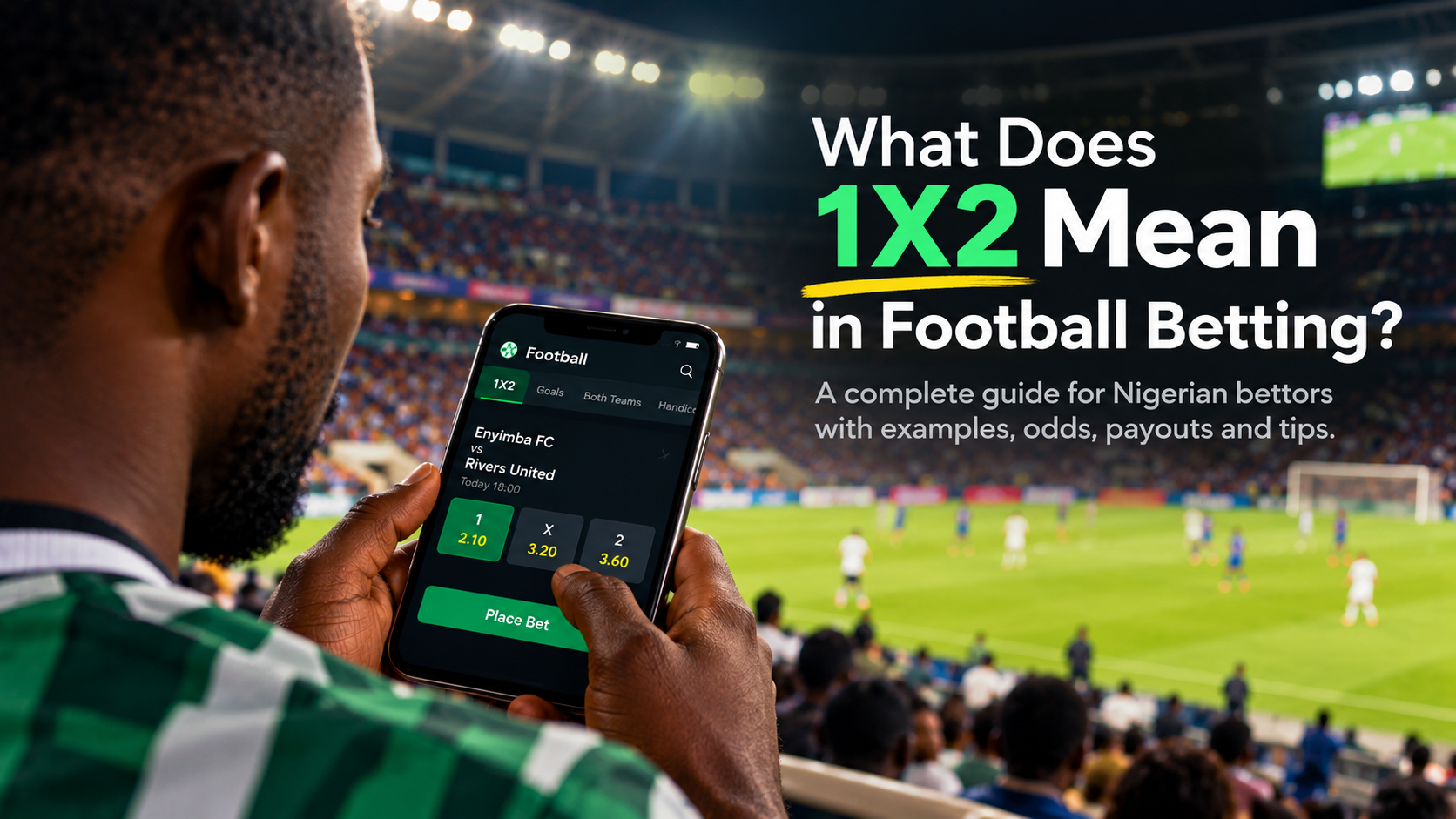
1X2 in football betting means choosing one of three possible match outcomes: 1 for a home win, X for a draw, or 2 for an away win. Each selection represents a different result, and only the outcome that matches the final score wins under standard settlement rules.
For example, imagine Enyimba playing at home against Rivers United in the Nigeria Premier Football League (NPFL). A selection of 1 means Enyimba must win, while X requires the match to finish level. Alternatively, choosing 2 means Rivers United must secure an away victory.
Although the basic concept is straightforward, understanding the market involves more than recognising three symbols. Bettors must also consider match duration, decimal odds, bookmaker margins and the differences between 1X2 and other football betting markets.
Furthermore, a team winning after extra time does not necessarily mean a standard 1X2 selection wins. Similarly, selecting a favourite does not guarantee success, regardless of how short the odds appear.
This comprehensive guide explains what 1X2 means in football betting, how the market works, how to calculate potential payouts in Nigerian naira and what happens when a match finishes in a draw. It also covers implied probability, expected value, accumulators and common settlement mistakes.
1X2 Meaning in Betting: What Do 1, X and 2 Stand For?
The term 1X2 refers to the three possible results of a football match: a home victory, a draw or an away victory.
| Symbol | Meaning | Winning condition |
|---|---|---|
| 1 | Home win | Home team wins |
| X | Draw | Both teams finish with equal goals |
| 2 | Away win | Away team wins |
Each symbol represents a separate selection. Therefore, choosing 1 does not also cover X or 2.
Consider a hypothetical Premier League fixture between Arsenal and Chelsea, with Arsenal listed as the home team.
An Arsenal victory produces a winning result of 1. Meanwhile, a draw produces X, whereas a Chelsea victory produces 2.
Importantly, these symbols do not indicate the number of goals scored. Instead, they identify the match result according to the home and away teams.
What Does 1 Mean in Football Betting?
1 means the home team must win the match.
Suppose Arsenal host Chelsea. Selecting 1 means Arsenal must finish with more goals than Chelsea during the relevant settlement period.
For instance, an Arsenal victory by 1–0, 2–1 or 4–2 satisfies the selection.
However, a 0–0 draw or 1–1 result loses because Arsenal have not won. Likewise, a Chelsea victory results in a losing home-win selection.
The winning margin does not matter in a standard 1X2 market. Consequently, a narrow victory and a comfortable victory produce the same outcome.
What Does X Mean in Football Betting?
X means the match must finish in a draw.
A draw occurs when both teams have scored the same number of goals at the end of the specified period.
Common examples include 0–0, 1–1, 2–2 and 3–3.
Notably, both teams do not need to score for X to win. A goalless draw still qualifies because neither team has scored more than the other.
By contrast, a 2–1 result loses because the match has a winner.
Although some people use the word tie, bookmakers commonly display the draw selection as X.
What Does 2 Mean in Football Betting?
2 means the away team must win the match.
Imagine Manchester United hosting Liverpool. In this situation, choosing 2 means Liverpool must win.
An away victory by 0–1, 1–2 or 2–3 satisfies the selection. Conversely, a draw or Manchester United victory loses.
Before confirming any selection, identify the teams from the bookmaker’s actual fixture listing. A club appearing first in a news headline does not necessarily mean it is playing at home.
Ultimately, the displayed market and the operator’s settlement rules determine which outcome the selection represents.
Complete 1X2 Results Table: Which Scores Win?
Every completed football match has one of three possible results under standard match-result rules.
The table below explains how common scores correspond to 1, X and 2.
| Final score (home–away) | Winning selection | Result |
|---|---|---|
| 0–0 | X | Draw |
| 1–0 | 1 | Home win |
| 0–1 | 2 | Away win |
| 1–1 | X | Draw |
| 2–0 | 1 | Home win |
| 0–2 | 2 | Away win |
| 2–1 | 1 | Home win |
| 1–2 | 2 | Away win |
| 2–2 | X | Draw |
| 3–0 | 1 | Home win |
| 0–3 | 2 | Away win |
| 3–2 | 1 | Home win |
| 2–3 | 2 | Away win |
| 3–3 | X | Draw |
| 4–1 | 1 | Home win |
| 1–4 | 2 | Away win |
When the home team scores more goals, 1 wins. Equal scores produce X, while an away team scoring more goals produces 2.
Consequently, predicting an exact score is unnecessary when selecting a standard 1X2 outcome.
How Does 1X2 Betting Work on a Football Betting Slip?
A football betting slip usually displays the selected match, betting market, outcome, decimal odds, stake and potential return.
To understand how these details work together, consider a hypothetical NPFL fixture.
Enyimba vs Rivers United
| Selection | Meaning | Decimal odds |
|---|---|---|
| 1 | Enyimba to win | 2.10 |
| X | Match to finish level | 3.20 |
| 2 | Rivers United to win | 3.60 |
These odds are examples rather than live bookmaker prices.
Selecting Enyimba at 2.10 means backing the home team to win. If Enyimba secure victory, the selection wins at the quoted odds.
However, a draw or Rivers United victory causes that selection to lose.
Meanwhile, choosing X at 3.20 requires the match to finish level. An away-win selection at 3.60 succeeds only if Rivers United win.
Why the Market Label Matters
The symbols 1, X and 2 can appear in several football betting markets.
For example, Full-Time Result — 1 means the home team must win the full-time match-result market.
In contrast, First-Half Result — 1 means the home team must be leading at half-time.
Although both selections contain the number 1, their settlement periods differ.
Furthermore, a qualification market or handicap market may use different rules from standard 1X2.
Therefore, checking the complete market name is essential before interpreting a selection.
How to Calculate 1X2 Betting Winnings in Nigerian Naira
Most Nigerian football betting platforms use decimal odds.
These odds determine the total potential return from a winning selection, including the original stake.
The calculation is straightforward:
Total return = Stake multiplied by decimal odds
To determine net profit, subtract the original stake from the total return.
If a selection loses, the normal return is zero. Consequently, the original stake is lost.
Example 1: ₦1,000 on a Home Win at 2.10
Suppose Enyimba are priced at 2.10 to win at home.
A hypothetical ₦1,000 stake produces a total winning return of ₦2,100.
After subtracting the original ₦1,000 stake, the net profit is ₦1,100.
However, the return applies only if Enyimba win. A draw or away victory loses the selection.
Example 2: ₦2,500 on a Draw at 3.20
Imagine the draw is priced at 3.20.
Multiplying a ₦2,500 stake by 3.20 produces a potential total return of ₦8,000.
Therefore, the net profit would be ₦5,500 if the match finishes level.
Otherwise, a home or away victory results in a losing selection.
Example 3: ₦5,000 on an Away Win at 3.60
Consider Rivers United at hypothetical away-win odds of 3.60.
A ₦5,000 winning stake would return ₦18,000, including the original stake.
The corresponding net profit would be ₦13,000.
Nevertheless, higher potential returns do not automatically indicate a better selection. Longer odds commonly reflect a lower market-implied chance of success.
As a result, potential payout and probability should be evaluated separately.
1X2 Betting Payout Table
| Stake | Decimal odds | Total winning return | Net profit |
|---|---|---|---|
| ₦500 | 1.50 | ₦750 | ₦250 |
| ₦1,000 | 1.80 | ₦1,800 | ₦800 |
| ₦2,000 | 2.00 | ₦4,000 | ₦2,000 |
| ₦2,500 | 2.40 | ₦6,000 | ₦3,500 |
| ₦3,000 | 3.00 | ₦9,000 | ₦6,000 |
| ₦5,000 | 3.50 | ₦17,500 | ₦12,500 |
| ₦10,000 | 4.20 | ₦42,000 | ₦32,000 |
These examples assume successful selections without special deductions or promotional conditions.
Importantly, the total return includes the original stake. Net profit refers only to the amount gained beyond that stake.
What Do 1X2 Odds Tell You About a Football Match?
A 1X2 market assigns different odds to the home win, draw and away win.
Generally, shorter odds indicate that the market considers an outcome more likely. Conversely, longer odds suggest a lower implied probability.
However, bookmaker prices are not exact measurements of the true chances of each result.
Instead, they reflect market assessments that may include a bookmaker margin.
Additionally, odds can change when new information becomes available, including team news, injuries and market activity.
How to Convert Decimal Odds Into Implied Probability
Implied probability expresses the relationship between decimal odds and the likelihood represented by those odds.
To calculate it, divide 100 by the decimal odds.
For example:
| Decimal odds | Raw implied probability |
|---|---|
| 1.50 | 66.67% |
| 2.00 | 50.00% |
| 2.50 | 40.00% |
| 3.00 | 33.33% |
| 4.00 | 25.00% |
| 5.00 | 20.00% |
At odds of 2.00, the raw implied probability is 50%.
Meanwhile, odds of 4.00 correspond to 25%.
Although these conversions are mathematically correct, they do not establish the true probability of a football result.
Bookmaker margins must also be considered.
How Bookmaker Margin Works in the 1X2 Market
Bookmakers generally include a margin in their odds. As a result, the combined implied probabilities of all three outcomes often exceed 100%.
This additional percentage is known as the bookmaker’s overround.
To calculate it, divide one by each outcome’s decimal odds. Next, add the three results together.
Consider a hypothetical football match with the following prices.
| Match outcome | Decimal odds | Implied probability |
|---|---|---|
| Home win | 2.10 | 47.62% |
| Draw | 3.20 | 31.25% |
| Away win | 3.60 | 27.78% |
| Total | — | 106.65% |
The home-win odds of 2.10 produce an implied probability of approximately 47.62%. Meanwhile, the draw odds of 3.20 correspond to 31.25%. Finally, the away-win odds of 3.60 represent approximately 27.78%.
Together, these percentages produce a total of 106.65%.
Since the three possible match outcomes are mutually exclusive, their actual probabilities must total 100%. Therefore, the additional 6.65 percentage points represent the market’s quoted overround.
However, this figure does not guarantee that a bookmaker earns 6.65% profit. Actual earnings depend on betting activity, the distribution of stakes and match results.
How to Estimate Margin-Adjusted Probabilities
You can also estimate probabilities after removing the bookmaker’s margin.
First, calculate the implied probability for each outcome. Next, divide each percentage by the combined total of 106.65%. Finally, multiply the result by 100.
Using this proportional adjustment produces the following estimates.
| Outcome | Original implied probability | Adjusted probability |
|---|---|---|
| Home win | 47.62% | 44.65% |
| Draw | 31.25% | 29.30% |
| Away win | 27.78% | 26.05% |
| Total | 106.65% | 100% |
These adjusted figures provide a simplified interpretation of the market. Nevertheless, they should not be mistaken for the true probabilities of each result.
Different bookmakers may distribute their margins differently. Furthermore, probability estimates can change when new information becomes available.
Consequently, understanding bookmaker margins helps readers interpret odds more accurately without assuming that the prices guarantee a particular result.
How to Calculate Fair 1X2 Odds
Fair odds represent theoretical prices without a bookmaker margin.
They are calculated using an estimated probability for a particular outcome.
To obtain fair decimal odds, divide one by the estimated probability expressed as a decimal.
For example, suppose an analyst estimates the following probabilities for a hypothetical match.
| Match outcome | Estimated probability | Fair decimal odds |
|---|---|---|
| Home win | 50% | 2.00 |
| Draw | 28% | 3.57 |
| Away win | 22% | 4.55 |
| Total | 100% | — |
These estimates are hypothetical and do not represent an actual upcoming fixture.
If the bookmaker offers home-win odds of 1.80, the price is below the estimated fair odds of 2.00.
However, a home-win price of 2.15 would be higher than that theoretical estimate.
Whether the higher price represents genuine value depends on the accuracy of the probability assessment.
Indeed, unreliable probability estimates can make unattractive selections appear favourable.
Therefore, fair-odds calculations provide a framework for analysing prices rather than a guarantee of profitable results.
Expected Value in 1X2 Betting: Why High Odds Do Not Guarantee Value
Expected value, commonly abbreviated as EV, measures the theoretical average profit or loss of a selection under an assumed probability.
In other words, it helps explain whether the offered odds are favourable relative to an estimated chance of winning.
However, positive expected value does not guarantee that an individual selection will win.
Example 1: Home Win at Odds of 2.10
Suppose an analyst estimates that a home team has a 50% chance of winning. Meanwhile, the bookmaker offers decimal odds of 2.10.
To calculate expected value, multiply the estimated winning probability by the decimal odds. Afterwards, subtract one from the result.
In this example, multiplying 0.50 by 2.10 gives 1.05. After subtracting one, the expected value becomes +0.05, equivalent to +5% of the stake.
For a hypothetical ₦2,000 stake, this represents a theoretical expected profit of ₦100 under the assumed probability.
Nevertheless, the actual match can still end in a draw or away victory. If that happens, the home-win selection loses the full ₦2,000 stake.
Therefore, expected value describes a mathematical expectation rather than a guaranteed payout.
Example 2: Same Team, Worse Price
Now imagine the bookmaker reduces the home-win odds from 2.10 to 1.80.
The estimated probability remains 50%. However, the potential return is now lower.
Multiplying 0.50 by 1.80 gives 0.90. After subtracting one, the expected value becomes −0.10, equivalent to −10% of the stake.
Consequently, the same team can represent different theoretical value depending on the available odds.
At 2.10, the calculation produces a positive expected value. By contrast, odds of 1.80 produce a negative expected value under the same probability assumption.
This comparison illustrates an important distinction: the team most likely to win is not automatically the selection offering the best mathematical value.
Furthermore, these calculations depend entirely on the accuracy of the estimated probability. An unreliable estimate can make an unfavourable selection appear attractive.
Expected Value Comparison Table
| Estimated win probability | Decimal odds | Expected value |
|---|---|---|
| 50% | 2.10 | +5% |
| 50% | 1.80 | −10% |
| 40% | 2.50 | 0% |
| 40% | 3.00 | +20% |
| 60% | 1.50 | −10% |
All probabilities are hypothetical and provided for educational purposes.
Although positive figures may look appealing, actual outcomes remain uncertain. Therefore, expected value should never be interpreted as a promise of profit.
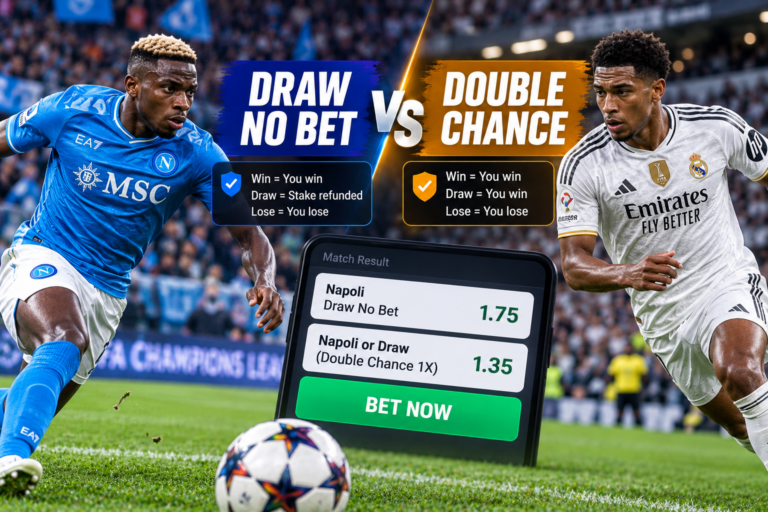
What Is the Difference Between 1X2 and Double Chance?
Both markets concern football match results, but they cover different numbers of possible outcomes.
A standard 1X2 selection covers exactly one result. By contrast, Double Chance combines two possible results into a single selection.
The three Double Chance options are:
- 1X: Home win or draw.
- X2: Draw or away win.
- 12: Home win or away win.
For example, selecting 1X on Enyimba means the selection wins if Enyimba win or the match finishes level.
However, choosing 1 in standard 1X2 betting requires Enyimba to win outright.
1X2 vs Double Chance Settlement Table
| Match result | 1 | X | 2 | 1X | X2 | 12 |
|---|---|---|---|---|---|---|
| Home win | Win | Lose | Lose | Win | Lose | Win |
| Draw | Lose | Win | Lose | Win | Win | Lose |
| Away win | Lose | Lose | Win | Lose | Win | Win |
Because Double Chance covers two results, its odds are generally lower than comparable single-outcome 1X2 prices.
Nevertheless, covering additional outcomes does not guarantee profitability.
For a complete explanation, read our Double Chance betting guide for Nigeria.
Does 1X Mean the Same Thing as 1X2?
No. The terms refer to different betting concepts.
1X is a Double Chance selection covering a home win or draw.
Meanwhile, 1X2 refers to the complete three-outcome match-result market.
Consequently, confusing the two can result in selecting a different outcome from the one intended.
1X2 vs Draw No Bet: What Happens When a Match Ends in a Draw?
Draw No Bet, often abbreviated as DNB, changes how a drawn match is settled.
In standard 1X2 betting, selecting the home or away team loses if the match finishes level.
However, a qualifying draw in the Draw No Bet market normally results in a refund of the original stake.
Consider Arsenal hosting Chelsea.
Selecting Arsenal to win in standard 1X2 loses if the match finishes 1–1. By contrast, Arsenal Draw No Bet normally returns the stake on the same result.
1X2 Home Win vs Home Draw No Bet
| Match result | 1X2 home win | Home Draw No Bet |
|---|---|---|
| Home victory | Win | Win |
| Draw | Lose | Refund |
| Away victory | Lose | Lose |
The refund condition generally leads to lower odds for Draw No Bet compared with an equivalent standard home-win selection.
Nevertheless, neither market removes the possibility of losing money.
For a detailed explanation of DNB settlement, refunds and accumulator rules, read What Is Draw No Bet in Football Betting?.
Is 1X2 the Same as Over and Under Goals?
No. These markets assess different aspects of a football match.
1X2 concerns which team wins or whether the match finishes level.
In contrast, Over/Under Goals concerns the number of goals scored relative to a specified line.
For example, Over 2.5 Goals requires at least three goals during the relevant settlement period.
A 2–1 home victory satisfies both home-win 1X2 and Over 2.5 Goals.
However, a 1–0 home victory wins home 1X2 while losing Over 2.5 Goals.
Comparing Match Result and Total Goals
| Final score | Winning 1X2 result | Over 2.5 Goals |
|---|---|---|
| 1–0 | 1 | Lose |
| 2–0 | 1 | Lose |
| 2–1 | 1 | Win |
| 1–1 | X | Lose |
| 2–2 | X | Win |
| 0–3 | 2 | Win |
| 0–0 | X | Lose |
Therefore, a match can produce a winning 1X2 selection and a losing goals selection, or the reverse.
For additional explanations of goal lines, see our Over and Under Goals betting guide.
Does 1X2 Include Extra Time and Penalties?
Standard full-time football 1X2 markets normally settle after 90 minutes plus stoppage time. Extra time and penalty shootouts are generally excluded unless the market explicitly states otherwise.
This distinction becomes particularly important during knockout competitions.
A team can advance to the next round without winning the standard 90-minute match.
Example: A Cup Match Decided After Extra Time
Suppose Arsenal face Chelsea in a knockout fixture.
| Match stage | Score |
|---|---|
| After 90 minutes plus stoppage | 1–1 |
| After extra time | 2–1 |
| Team advancing | Arsenal |
A standard 90-minute 1X2 market settles as X, because the match was level at the end of regulation time.
Consequently, an Arsenal home-win selection loses under that market, even though Arsenal eventually win after extra time.
However, a separate qualification market backing Arsenal to progress may win.
These markets have different settlement conditions. Therefore, their results should not be treated as interchangeable.
Does Stoppage Time Count in 1X2?
Yes. Standard full-time football markets normally include stoppage time added by the referee.
For instance, a winning goal scored at 90+4 minutes counts towards the regulation-time result.
Extra time, however, refers to additional periods played after regulation time in certain knockout matches.
As a result, confusing stoppage time with extra time can lead to incorrect settlement expectations.
Do Penalty Shootouts Count?
Penalty shootouts generally do not count towards the standard 90-minute 1X2 result.
For example, a match finishing 0–0 after regulation time remains X for that market, even if one team later wins a penalty shootout.
Always check whether the selected market concerns regulation time, extra time, qualification or another specifically defined outcome.
First-Half 1X2 vs Full-Time 1X2
Some bookmakers offer separate match-result markets for individual periods.
A first-half 1X2 selection considers only the score at half-time.
Meanwhile, standard full-time 1X2 concerns the result at the end of regulation time.
Consequently, the two markets can produce different winning selections during the same fixture.
Example: Home Team Comes From Behind
Suppose Enyimba trail Rivers United 0–1 at half-time but eventually win 2–1.
The first-half 1X2 result is 2, because Rivers United were leading at the interval.
However, the full-time result is 1, because Enyimba finish with more goals.
Half-Time and Full-Time Results Table
| Half-time score | Full-time score | First-half 1X2 | Full-time 1X2 |
|---|---|---|---|
| 0–0 | 2–1 | X | 1 |
| 1–0 | 1–1 | 1 | X |
| 0–1 | 2–1 | 2 | 1 |
| 1–1 | 1–2 | X | 2 |
| 2–0 | 2–2 | 1 | X |
| 0–2 | 1–3 | 2 | 2 |
These examples show why the settlement period matters as much as the selected symbol.
Is Second-Half 1X2 Based on the Final Score?
Not necessarily.
A second-half 1X2 market normally considers only goals scored during the second half rather than the cumulative final score.
For example, suppose a match is 2–0 at half-time and finishes 2–1.
Although the home team wins the full match, the away team wins the second half by one goal to nil.
Therefore, a second-half selection of 2 may win even when the away team loses the match overall.
Nevertheless, the bookmaker’s specific market rules remain decisive.
What Does Half-Time/Full-Time 1X2 Mean?
Half-Time/Full-Time, commonly abbreviated as HT/FT, combines two separate result predictions.
The first symbol represents the half-time outcome. Meanwhile, the second represents the full-time result.
For example, 1/1 means the home team must lead at half-time and win at full-time.
By contrast, X/1 requires the match to be level at half-time before the home team wins.
There are nine possible combinations because each period has three possible results.
| HT/FT selection | Required sequence |
|---|---|
| 1/1 | Home lead, then home win |
| 1/X | Home lead, then draw |
| 1/2 | Home lead, then away win |
| X/1 | Half-time draw, then home win |
| X/X | Draw at half-time and full-time |
| X/2 | Half-time draw, then away win |
| 2/1 | Away lead, then home win |
| 2/X | Away lead, then draw |
| 2/2 | Away lead, then away win |
HT/FT is more specific than ordinary full-time 1X2.
For instance, a home team may win the match but fail an HT/FT 1/1 selection if the first half finishes level.
Consequently, HT/FT prices and settlement conditions differ from those of standard match-result betting.
What Happens to 1X2 in an Accumulator?
An accumulator combines multiple selections into a single ticket.
Under standard rules, every active selection must win for the accumulator to succeed.
To calculate the combined decimal odds, multiply the individual odds together.
Example: Three 1X2 Selections
Consider a hypothetical accumulator containing the following selections.
| Selection | Decimal odds | Hypothetical outcome |
|---|---|---|
| Arsenal home win | 1.70 | Win |
| Barcelona home win | 1.60 | Win |
| Inter away win | 2.10 | Win |
Multiplying the three prices produces combined odds of 5.712.
For a hypothetical ₦2,000 stake, the total winning return would be ₦11,424.
After subtracting the original stake, the net profit would be ₦9,424.
However, this return requires all three selections to win under the ticket’s settlement rules.
If Barcelona draw, the Barcelona home-win selection loses. Consequently, the accumulator normally loses even if Arsenal and Inter both win.
Does a Draw Void a 1X2 Accumulator Leg?
No. A draw does not normally void a standard home-win or away-win selection.
Selecting 1 loses when the result is X. Similarly, choosing 2 loses when the match finishes level.
By contrast, Draw No Bet normally refunds a qualifying draw.
Other circumstances, such as postponement or abandonment, may produce void outcomes under the bookmaker’s rules.
Therefore, a normal draw and an event-related void must be treated differently.
What Happens When a 1X2 Match Is Postponed or Abandoned?
Not every football match reaches a normal final result.
Fixtures may be postponed, abandoned, cancelled or interrupted. In those situations, the bookmaker’s settlement rules determine what happens to the selection.
Postponed Matches
A postponed fixture may remain active if it is played within the period specified by the operator.
However, a match that is not completed within the permitted timeframe may result in a void selection.
Importantly, these timeframes can differ between bookmakers.
Abandoned Matches
An abandoned match may also result in a void selection, depending on the market and applicable rules.
For instance, some markets may already have an irreversible outcome, while ordinary full-time result markets generally require a valid final result.
Nevertheless, settlement depends on the operator’s rules and the official status of the event.
Void Selections in Accumulators
When an accumulator leg is legitimately voided, its decimal odds are commonly replaced by 1.00.
The remaining active selections then determine the ticket’s result.
However, promotional offers and free bets may follow additional conditions.
Consequently, bettors should distinguish a losing selection from one that has been officially voided.
How to Compare 1X2 Odds Across Bookmakers
Different bookmakers may offer different prices for the same football outcome.
For example, imagine two operators quoting home-win odds for an identical fixture.
| Bookmaker | Home-win odds | Winning return on ₦5,000 |
|---|---|---|
| Bookmaker A | 1.80 | ₦9,000 |
| Bookmaker B | 1.95 | ₦9,750 |
Bookmaker B offers ₦750 more in total return if the selection wins.
However, the comparison is valid only when both prices refer to the same event, outcome and settlement period.
A standard 90-minute home-win market should not be compared directly with a qualification market.
Likewise, handicap-adjusted results have different conditions from ordinary 1X2 selections.
Why Higher Odds Do Not Guarantee Better Predictions
A higher price increases the potential payout for the same winning outcome.
Nevertheless, it does not increase the probability that the result will occur.
For example, a team with a low chance of winning may still represent an unattractive selection at relatively high odds.
Therefore, comparing bookmaker prices and estimating probabilities are separate analytical tasks.
Does Backing the Favourite in 1X2 Guarantee a Win?
No. A favourite is simply the outcome priced as more likely than the alternatives within the market.
Suppose a home team has hypothetical decimal odds of 1.40.
Those odds correspond to a raw implied probability of approximately 71.43%.
However, that still leaves a meaningful possibility of another result, even before considering bookmaker margin.
Consequently, short odds should never be interpreted as certainty.
A favourite can lose because of defensive mistakes, tactical changes, injuries, red cards or unexpected performances.
Similarly, an underdog can win despite being assigned longer odds.
Why Recent Winning Percentage Can Be Misleading
Imagine a team has won seven of its last ten matches.
Although that record may appear impressive, it does not establish a 70% probability of winning the next fixture.
For instance, previous opponents may have been weaker, or the team may have played most of those matches at home.
Furthermore, important players might now be unavailable.
Therefore, recent results require context before they can support a meaningful assessment.
How to Analyse a 1X2 Football Match Without Relying on Guesswork
Understanding the market is different from predicting the outcome.
A useful assessment should consider several relevant factors rather than relying on one isolated statistic.
Home and Away Performance
A club’s overall league position can conceal differences between its home and away performances.
For example, a team may win frequently at home but struggle to create chances when travelling.
Therefore, separate home and away records may provide more useful information than total league points alone.
However, small samples can exaggerate apparent patterns.
Opposition Strength
Winning against weaker opponents does not necessarily imply the same chance of success against a leading team.
Consequently, recent results should be interpreted alongside the quality of the opposition.
Likewise, several defeats against strong opponents may not indicate that a team is performing as poorly as its results suggest.
Injuries and Suspensions
Player availability can influence team performance.
For instance, missing a first-choice goalkeeper, central defender or leading forward may affect tactical options.
Nevertheless, the impact depends on available replacements and the team’s overall structure.
Fixture Congestion and Rest
Teams competing in several competitions may have limited recovery time.
As a result, travel, short turnarounds and squad rotation can affect performances.
However, these factors should be considered alongside squad depth rather than treated as automatic reasons for defeat.
Expected Goals and Chance Quality
Expected goals, commonly abbreviated as xG, estimate the quality of scoring opportunities using characteristics of individual chances.
This information can help distinguish between teams creating consistently good opportunities and those relying on unusually effective finishing.
However, xG models vary, and previous xG figures do not guarantee future results.
Draw Probability
Because 1X2 contains a separate draw outcome, comparing only the strength of the two teams is incomplete.
For example, two clubs may have similar chances of winning while the match still carries a substantial probability of finishing level.
Therefore, a complete assessment must consider home win, draw and away win probabilities that total 100%.
Ten Common 1X2 Betting Mistakes
1. Thinking 1 Means One Goal
The number 1 identifies the home-win selection rather than a specific goal total.
For example, a 3–0 home victory still wins a standard selection of 1.
2. Thinking 2 Means Two Goals
The number 2 represents the away-win selection.
Consequently, an away victory by 0–1 wins even though the away team scores only once.
3. Assuming a Draw Refunds a Team-Win Selection
Standard 1X2 home-win and away-win selections lose when the match finishes level.
By contrast, Draw No Bet normally refunds a qualifying draw.
4. Confusing 1X2 With Double Chance
A standard 1X2 selection covers one outcome.
Meanwhile, Double Chance selections cover two outcomes.
Although their symbols look similar, their settlement rules differ.
5. Counting Extra-Time Goals Automatically
Standard full-time 1X2 normally excludes extra time and penalties.
Therefore, winning a knockout match after extra time does not necessarily produce a winning 90-minute selection.
6. Treating Short Odds as a Guarantee
A short price suggests a relatively high market-implied probability.
However, no ordinary 1X2 outcome is certain before the match begins.
7. Ignoring Bookmaker Margin
The raw implied probabilities of all three outcomes often total more than 100%.
Consequently, they should not automatically be treated as the true probabilities.
8. Confusing Return With Profit
A winning ₦5,000 stake at odds of 2.00 produces a total return of ₦10,000.
However, the net profit is ₦5,000 because the return includes the original stake.
9. Assuming Every Accumulator Draw Is Void
A draw normally loses an accumulator leg when the selection is a standard home win or away win.
Only applicable void conditions trigger the usual replacement of the selection’s odds with 1.00.
10. Comparing Different Markets as Though They Are Identical
Home win after 90 minutes, home team to qualify and home Asian Handicap −1 are different selections.
Even when the same team is involved, their settlement conditions can differ substantially.
1X2 Football Betting: Quick Reference Table
| Question | Answer |
|---|---|
| What does 1X2 mean? | Home win, draw, away win |
| What does 1 mean? | Home team wins |
| What does X mean? | Match finishes level |
| What does 2 mean? | Away team wins |
| Does 1X2 require an exact score? | No |
| Does 0–0 count as X? | Yes |
| Does a draw refund 1 or 2? | Normally no |
| Does stoppage time count? | Normally yes |
| Does extra time count? | Normally no |
| Do penalty shootouts count? | Normally no |
| Is 1X2 the same as Double Chance? | No |
| Is 1X2 the same as Draw No Bet? | No |
| Can 1X2 be used in accumulators? | Yes |
| Can a selection be voided? | Yes, under applicable rules |
| Do higher odds guarantee value? | No |
| Does backing the favourite guarantee success? | No |
Frequently Asked Questions About 1X2 Betting
What does 1X2 mean in football betting?
1X2 means selecting one of three match results: home win, draw or away win. Specifically, 1 represents a home victory, X represents a draw, and 2 represents an away victory.
What does 1 mean in betting?
The number 1 means the home team must win within the specified settlement period. Importantly, it does not refer to the number of goals scored.
What does X mean in betting?
X represents a draw. Therefore, scores such as 0–0, 1–1 and 2–2 satisfy the selection.
What does 2 mean in betting?
The number 2 represents an away victory. Usually, the away team appears second in the bookmaker’s fixture listing.
What is the difference between 1X and 1X2?
1X is a Double Chance selection covering a home win or draw. In contrast, 1X2 is the complete market containing three separate match-result selections.
Does 1X2 include extra time?
Standard full-time 1X2 normally covers 90 minutes plus stoppage time. However, extra time and penalty shootouts are generally excluded unless the market states otherwise.
What happens if I select 1 and the match finishes 1–1?
The selection loses because the home team did not win. Therefore, a standard home-win 1X2 selection does not normally refund a draw.
Does 0–0 count as X?
Yes. Since both teams finish with equal goals, 0–0 qualifies as a draw.
How do I calculate 1X2 winnings in naira?
Multiply the original stake by the decimal odds to determine the total winning return. For example, ₦2,000 at odds of 2.50 produces a return of ₦5,000. After subtracting the stake, the net profit is ₦3,000.
Can 1X2 be used in an accumulator?
Yes. Multiple 1X2 selections can be combined into an accumulator. However, every active selection normally needs to win for the ticket to succeed.
Is 1X2 the same as Draw No Bet?
No. A standard 1X2 team-win selection loses if the match finishes level. By contrast, Draw No Bet normally refunds the stake on a qualifying draw.
Can a 1X2 selection be voided?
Yes. Postponed, abandoned or cancelled matches may result in void selections under the bookmaker’s rules. However, a normal draw does not void a standard home-win or away-win selection.
How do bookmakers calculate 1X2 odds?
Bookmakers use statistical assessments, market information and pricing margins to establish separate prices for home win, draw and away win. Additionally, these prices may change as new information becomes available.
Is 1X2 betting profitable?
No betting market guarantees profit. Instead, profitability depends on the accuracy of probability estimates, the prices offered and actual match results. Furthermore, bookmaker margins affect the mathematical value of selections.
Final Explanation: Understanding 1X2 Before Reading Football Odds
The essential rule is straightforward: 1 means home win, X means draw, and 2 means away win.
However, understanding the symbols is only the beginning.
Decimal odds determine potential returns, while bookmaker rules establish which match period counts towards settlement. In addition, a normal draw loses standard home-win and away-win selections rather than triggering an automatic refund.
A complete understanding of 1X2 also requires distinguishing it from Double Chance, Draw No Bet, handicap betting and goals markets.
For Nigerian readers, naira-based examples make the calculations easier to follow. Nevertheless, larger potential returns should never be mistaken for a higher probability of success.
Ultimately, the most useful approach is to understand what each selection means, which result satisfies it and how the quoted price relates to the uncertainty of the match.
Explore the 8xbet9ja sports betting guide for further explanations of football betting terminology, market rules and decimal odds.
Responsible gambling: Betting involves financial risk. Only participate where legally permitted and if you meet the minimum age requirement. Set spending limits, avoid chasing losses and never treat gambling as a reliable source of income.