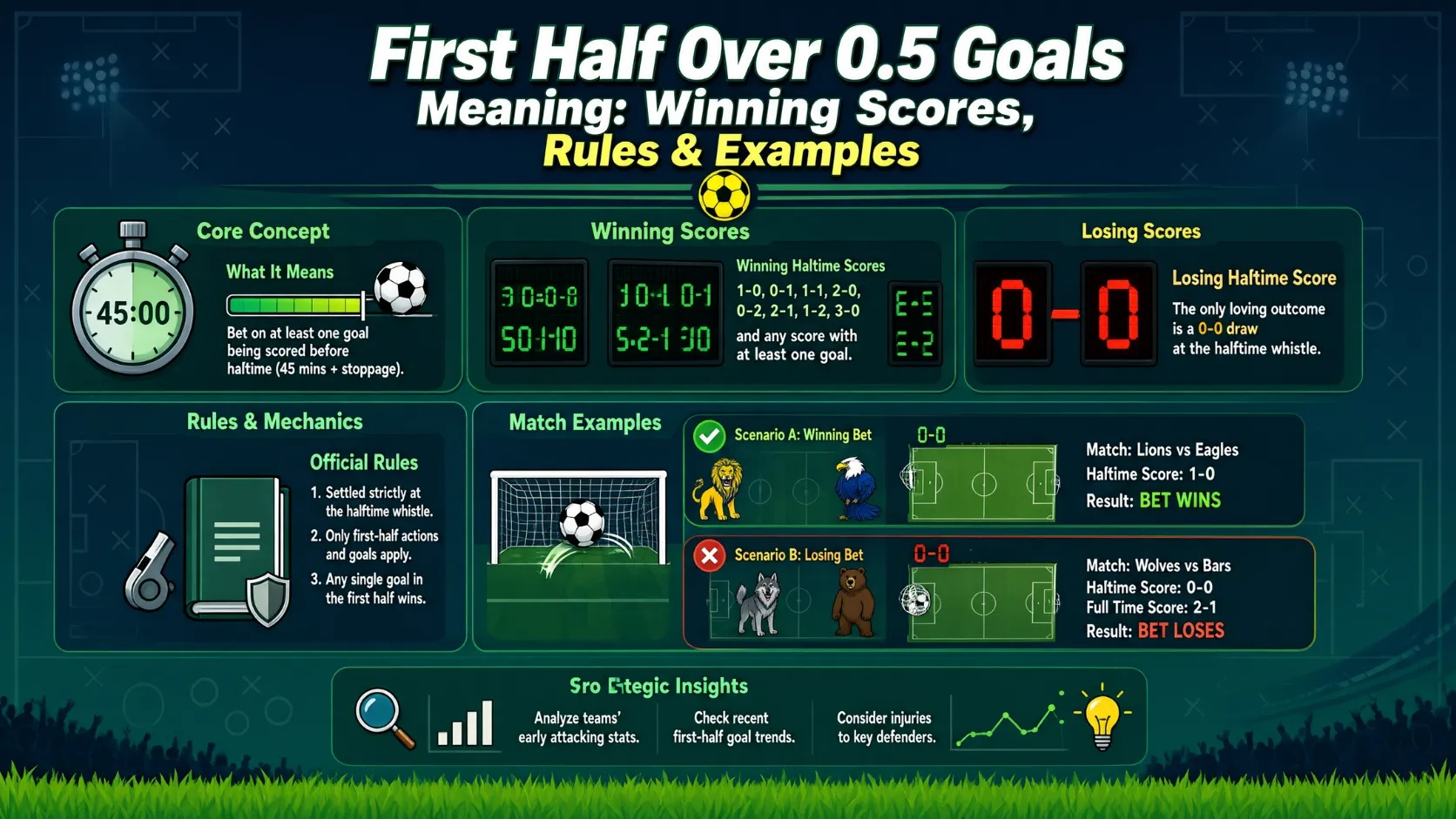
The first half over 0.5 goals meaning is simple: at least one goal must be scored by either team before half-time for the selection to win. This football betting market focuses on the opening 45 minutes and any applicable first-half stoppage time, rather than the final match score.
For example, Arsenal and Chelsea might reach half-time with a score of 1-0. In this case, Over 0.5 first-half goals wins because the teams have scored one goal. However, if the half-time score remains 0-0, the selection loses, even when the match eventually finishes 2-1.
Understanding this market requires knowing its goal threshold, settlement period, decimal odds and statistical considerations. This guide explains the rules with practical score examples and shows how to assess first-half scoring patterns without relying on assumptions or guaranteed predictions.
Quick answer: First Half Over 0.5 means at least one combined goal must occur before the half-time whistle. Either team can score. A 0-0 half-time result loses, while 1-0, 0-1, 1-1 and other scorelines containing at least one goal qualify.
What Does Over 0.5 First-Half Goals Mean?
Over 0.5 first-half goals is a football market that counts the goals scored by both teams during the opening period.
The number 0.5 represents the goal threshold. Since football scores use whole numbers, the selection needs at least one goal to go over that line.
Neither team needs to win. The home side can score, the away side can score, or both teams can find the net.
Consider these hypothetical half-time results:
- 1-0: Over 0.5 wins because the first-half total is one.
- 0-1: Over 0.5 wins because the away side has scored.
- 1-1: Over 0.5 wins because the teams have scored two goals.
- 2-0: Over 0.5 wins because the first-half total is two.
- 0-0: Over 0.5 loses because neither team has scored.
The market measures the combined goal total, not the identity of the scorer or the eventual match winner.
First Half Over 0.5 Goals: Winning and Losing Examples
The following table explains how different half-time scorelines affect a standard first-half match-goals selection.
| Half-time score | First-half goals | Over 0.5 result |
|---|---|---|
| 0-0 | 0 | Lose |
| 1-0 | 1 | Win |
| 0-1 | 1 | Win |
| 1-1 | 2 | Win |
| 2-0 | 2 | Win |
| 0-2 | 2 | Win |
| 2-1 | 3 | Win |
| 1-2 | 3 | Win |
| 3-0 | 3 | Win |
| 2-2 | 4 | Win |
The important point is that the first-half total determines the settlement. A team does not need to win, and the match does not need to produce several goals.
For instance, a 1-0 half-time score satisfies Over 0.5 even if the game finishes 1-0. Conversely, a match that reaches half-time at 0-0 does not satisfy this market simply because the teams score four goals after the interval.
Does a Goal in First-Half Stoppage Time Count?
Yes. Under standard first-half goals market rules, a goal during first-half stoppage time counts when the referee awards it before the half-time whistle.
A normal football match contains two 45-minute periods. However, the referee adds time for injuries, substitutions, disciplinary incidents, VAR checks and other interruptions.
As a result, the first half does not necessarily end when the clock reaches exactly 45 minutes.
Examples include:
- Goal at 12 minutes: Counts.
- Goal at 36 minutes: Counts.
- Goal at 45+1: Counts if awarded before half-time.
- Goal at 45+4: Counts if awarded before half-time.
- Goal after the interval and the second-half restart: Does not count towards the first-half total.
The International Football Association Board (IFAB) explains match duration and allowances for lost time in Law 7.
Official reference: IFAB / The FA — Law 7: Duration of the Match.
Always check the sportsbook’s settlement provisions as well. The operator’s published market rules determine how it treats unusual incidents and disputed events.
First Half Goals vs Full-Time Goals
A common mistake involves confusing a first-half goals selection with a full-time goals market. Although both markets count goals, they cover different periods.
Consider this example:
Arsenal vs Chelsea
- Half-time score: 0-0
- Full-time score: 2-1
- First-half total: 0
- Full-time total: 3
First Half Over 0.5 loses because neither team scored before the interval. However, Full-Time Over 0.5 wins because the match produced three goals.
Now consider another example:
- Half-time score: 1-0
- Full-time score: 1-0
- First-half total: 1
- Full-time total: 1
Both markets win, but their settlement periods remain different.
This distinction explains why a full-time goals prediction cannot automatically serve as a first-half prediction.
For a wider explanation of goals markets, visit our Over/Under goals betting guide.
First Half Over 0.5 vs First Half Over 1.5
These selections cover the same period but require different numbers of goals.
First Half Over 0.5: At least one goal must occur before half-time.
First Half Over 1.5: At least two goals must occur before half-time.
| Half-time score | Over 0.5 | Over 1.5 |
|---|---|---|
| 0-0 | Lose | Lose |
| 1-0 | Win | Lose |
| 0-1 | Win | Lose |
| 1-1 | Win | Win |
| 2-0 | Win | Win |
| 0-2 | Win | Win |
| 2-1 | Win | Win |
| 3-0 | Win | Win |
Over 1.5 requires an additional goal, so fewer half-time scorelines qualify.
The odds also reflect the difference in goal requirements. However, the actual price depends on the bookmaker’s assessment of the fixture.
Match Goals vs Individual Team Goals in the First Half
This distinction matters when you explore more specific football markets.
First-half match Over 0.5 combines goals from both teams.
Home team Over 0.5 first half counts only goals scored by the home team.
Away team Over 0.5 first half counts only goals scored by the away team.
Suppose the match reaches half-time at 0-1.
| Market | Result |
|---|---|
| First-half match Over 0.5 | Wins |
| Home team Over 0.5 | Loses |
| Away team Over 0.5 | Wins |
The match total qualifies because one goal has occurred. However, the home side has not scored.
Similarly, a 1-1 half-time result satisfies all three Over 0.5 selections because both teams have scored.
Always check whether the market refers to the combined match total or a particular team’s goals.
How Do First-Half Over 0.5 Odds Work?
Decimal odds determine the potential return when a selection wins.
Suppose a bookmaker offers 1.60 for First Half Over 0.5 and you stake ₦2,000.
Total return = Stake × Decimal odds
₦2,000 × 1.60 = ₦3,200.
Net profit = Total return − Stake
₦3,200 − ₦2,000 = ₦1,200.
These figures are illustrative, not live bookmaker quotations.
Calculate the Implied Probability
Decimal odds also provide a raw implied probability.
Use this formula:
Implied probability = (1 ÷ Decimal odds) × 100
At odds of 1.60:
1 ÷ 1.60 × 100 = 62.5%.
This percentage reflects the probability implied by the quoted price before accounting for the bookmaker’s margin. It does not establish that a goal will occur with a verified 62.5% probability.
For more information about decimal pricing, implied probability and potential returns, read our decimal odds explained guide.
How to Analyse First-Half Over 0.5 Goals Predictions
Understanding the market is different from assessing whether a particular fixture suits it.
A useful first-half goals analysis examines how frequently teams score early, how many opportunities they create before the interval and how effectively their opponents defend during the same period.
1. Examine First-Half Goals Scored
Start with each team’s goals before half-time rather than relying exclusively on its full-time scoring average.
A team might score regularly across 90 minutes but create very few chances during the opening period.
Review:
- Average first-half goals scored.
- Percentage of matches with at least one first-half goal.
- Frequency of scoring before half-time.
- First-half goals per home fixture.
- First-half goals per away fixture.
These figures provide a more relevant picture of early attacking output.
2. Compare First-Half Goals Conceded
A team’s defensive record matters just as much as its attacking output.
For example, a team might score infrequently but regularly concede early goals against stronger opponents.
Examine first-half goals conceded, half-time clean sheets and the frequency with which opponents score before the interval.
However, account for opposition strength. A record against weaker teams might not accurately represent the challenge in the upcoming fixture.
3. Assess First-Half Expected Goals
Expected goals, commonly known as xG, estimates the quality of scoring opportunities.
For this market, first-half xG offers more relevant information than full-match xG alone.
Consider these measurements:
- First-half xG: Quality of a team’s scoring opportunities before half-time.
- First-half xGA: Quality of the scoring opportunities it allows opponents to create.
- Full-match xG: Quality of chances across the complete match.
A team may create most of its opportunities after the interval. Consequently, its full-match xG could exaggerate its first-half attacking threat.
Expected goals remain model estimates, not guaranteed goal counts. Their accuracy also depends on the provider’s methodology and underlying data.
Reference: StatsBomb/Hudl — Expected Goals.
4. Review Shots on Target and Big Chances
Shot volume needs context.
Ten attempts from difficult positions do not necessarily indicate a greater scoring threat than three clear opportunities.
Review first-half shots on target, big chances created, attempts inside the penalty area and dangerous attacking sequences.
Together, these statistics provide more useful context than total shot counts alone.
5. Compare Home and Away Performance
Venue can influence attacking behaviour.
Some teams start aggressively at home, while others adopt a cautious approach away from their own stadium.
Compare the following:
- Home team’s first-half home scoring record.
- Home team’s first-half home conceding record.
- Away team’s first-half away scoring record.
- Away team’s first-half away conceding record.
This approach avoids treating every fixture in a team’s season as identical.
6. Check Starting Lineups and Attacking Availability
An unavailable striker, creative midfielder or important wide player can affect how frequently a team creates opportunities.
Likewise, a change in defensive personnel may influence the opponent’s chances.
Check confirmed lineups when available, injury updates and relevant suspensions. Avoid presenting rumours or unconfirmed lineups as established team news.
7. Consider Playing Style and Match Context
Tactical approaches influence the timing and quality of chances.
Two teams that press aggressively may create early transitions and space behind defensive lines. Conversely, sides that prioritise compact defensive organisation may reduce the number of clear opportunities.
However, neither playing style automatically determines the outcome.
Consider the actual matchup, recent tactical performances, competition context, rest periods and the likely approach of both managers.
Why First-Half Statistics Need Reliable Data
A useful prediction requires a verifiable statistical foundation.
However, football data providers do not all offer the same level of detail.
A basic results database may reveal whether a goal occurred before half-time. A more advanced provider may also supply first-half xG, shots, possession and event-level information.
Do not combine incompatible sources without checking their definitions.
For example, one provider might calculate first-half scoring percentages using league matches only, while another includes cup fixtures and friendlies.
A meaningful comparison should use a consistent competition, time period and sample.
Common Mistakes When Analysing First Half Over 0.5 Goals
Confusing Full-Time Statistics With First-Half Statistics
A team that averages two goals per match does not necessarily score during the opening period. Always examine first-half-specific performance.
Assuming Attacking Teams Must Score Early
Some attacking sides begin cautiously and produce most of their chances after the interval. Their overall scoring average does not establish their first-half pattern.
Ignoring the Opponent
Evaluate a team’s early scoring record against the defensive quality of its upcoming opponent.
Treating Recent Results as Guarantees
Previous matches provide evidence, not certainty. A run of first-half goals does not guarantee another goal in the next fixture.
Confusing Match Totals With Team Totals
A first-half match Over 0.5 selection can win through either team’s goal. A home team Over 0.5 selection specifically requires the home side to score.
Forgetting Stoppage Time
The first-half period normally includes applicable additional time. A goal before the actual half-time whistle can qualify even after the clock passes 45 minutes.
Assuming Every Operator Uses Identical Settlement Rules
Bookmakers publish their own market and settlement terms. Check the relevant rules for suspended, abandoned or unusual-format matches.
Can You Include First Half Over 0.5 in an Accumulator?
Yes. First-half Over 0.5 can form a standalone selection or an accumulator leg, depending on the bookmaker and fixture.
An accumulator combines several selections into one bet. Every required leg generally needs to win for the accumulator to succeed, subject to its settlement rules.
For example, an accumulator could contain three different first-half Over 0.5 selections. If one match finishes 0-0 at half-time, that leg normally loses and affects the entire accumulator.
Combining more selections also increases the number of outcomes that must be correct.
Before calculating a potential return, confirm the odds, market period and settlement terms for every leg.
Our accumulator odds guide for Nigeria explains combined decimal odds and potential returns.
First Half Over 0.5 Goals vs Other Football Markets
It helps to understand how this selection fits within the wider football betting market.
| Market | What it measures |
|---|---|
| First Half Over 0.5 | At least one combined goal before half-time |
| First Half Over 1.5 | At least two combined goals before half-time |
| First Half Under 0.5 | No combined goals before half-time |
| Full-Time Over 0.5 | At least one combined goal during the applicable full-match period |
| First-Half Team Over 0.5 | At least one goal by the specified team before half-time |
| Both Teams to Score | Whether both teams score during the applicable match period |
| Half-Time Result | Which team leads or whether the match is level at half-time |
These markets measure different outcomes. Therefore, an analyst should not automatically reuse a forecast from one market as a prediction for another.
For broader match-outcome analysis, explore our football betting predictions today hub.
What Happens If a Match Is Abandoned Before Half-Time?
An abandoned or suspended match requires separate consideration.
If a fixture stops before the first half finishes, the operator’s published rules determine how it settles the selection.
Depending on the circumstances, the operator may void the selection or apply a specific rule for completed portions of play.
Do not assume that every bookmaker settles an incomplete first-half market in the same way.
Check the operator’s abandoned-match, postponed-fixture and incomplete-event rules before interpreting the outcome.
Frequently Asked Questions About First Half Over 0.5 Goals
Market Meaning and Goal Requirements
What does First Half Over 0.5 mean?
First Half Over 0.5 means either team must score at least one combined goal before half-time. The selection wins when the first-half total reaches one or more goals.
How many goals are needed for First Half Over 0.5?
Only one goal is required. The home team or away team can score it. Additional first-half goals also satisfy the selection.
Does 0-0 at half-time lose Over 0.5?
Yes. A 0-0 half-time score means neither team has scored, so First Half Over 0.5 loses under standard settlement rules.
Is First Half Over 0.5 the same as Home Team Over 0.5?
No. The match-goals market combines goals from both teams. The home-team market only counts goals scored by the home side.
Timing and Settlement Rules
Does a goal in the 45th minute count?
Yes. A goal in the 45th minute counts when the referee awards it before the half-time whistle. First-half stoppage time also normally qualifies.
Does a goal in the 46th minute count for First Half Over 0.5?
A goal after the half-time interval and second-half restart belongs to the second half. It does not count towards a standard first-half total.
What if the match finishes 2-1 but half-time was 0-0?
First Half Over 0.5 loses because the opening period ended without a goal. The three full-time goals do not change the first-half result.
Does First Half Over 0.5 include extra time?
Normally, no. The market covers the first half of regular match play rather than the opening period of extra time. Check the operator’s rules for unusual competition formats.
Does First Half Over 0.5 have a refund when no goal is scored?
Normally, no. Zero goals fall below the 0.5 line, so the selection loses. A void or refund may apply only under specific incomplete-event or settlement rules.
Predictions, Statistics and Other Markets
Is First Half Over 0.5 the same as Full-Time Over 0.5?
No. First Half Over 0.5 counts goals before half-time, while Full-Time Over 0.5 covers the applicable full-match period. A goal after the interval can satisfy the full-time market but not the first-half selection.
Can First Half Over 0.5 win if the match finishes 0-0?
No. A 0-0 full-time result also contains zero first-half goals. The standard First Half Over 0.5 selection therefore loses.
How can I analyse First Half Over 0.5 predictions?
Review first-half goals scored and conceded, first-half xG, shots on target, home and away performance, confirmed lineups and tactical matchups. No statistic guarantees a goal.
Final notes on first half over 0.5 goals
First Half Over 0.5 goals requires one or more goals before half-time. Either team can provide the goal, but a 0-0 score at the interval means the selection loses.
Understanding the difference between first-half match totals, team totals and full-time goals markets prevents common interpretation mistakes. More importantly, first-half scoring statistics, expected goals, defensive records and team availability provide a stronger analytical foundation than general goal averages.
For more football analysis, explore our football predictions hub and Over/Under goals guide.
First-half goal statistics and probability estimates do not guarantee match outcomes. Betting involves financial risk. Check current market information and follow the applicable operator rules.
Sources and Further Reading
- The Football Association — IFAB Law 7: Duration of the Match — official explanation of match periods and allowances for lost time.
- IFAB — Laws of the Game — international football match-duration rules.
- StatsBomb/Hudl — Expected Goals — expected-goals methodology and shot-quality definitions.
- Best Football Prediction Site — Check out the best site for predictions.
Worked scorelines and financial calculations are illustrative, not live fixtures or bookmaker quotations.